Jan 18, 2011

Hristo Stoichkov: The Bulgarian Messiah


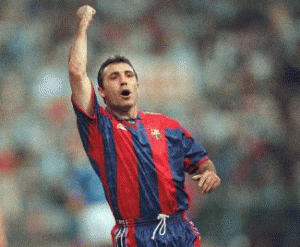
"There are only two Christ’s; one plays for Barcelona, the other is in heaven," so said Hristo Stoichkov before collecting his award for European Footballer of the Year in 1994.

With Hristo directly translating as Christ, you could be forgiven for thinking he was joking and that it was a play on words...but you'd be wrong. Stoichkov had three massive elements to his person, a God-given skill, a God-sized ego, and a Devil of a temperament.

Starting his career as a mere 16-year-old with local team Hebros, Stoickov quickly became the bright young star of Bulgarian football. Even then, his technical skills stood out.

As a left-sided winger, he terrorised teams with his pace and precision and it came as no surprise to see CSKA Sofia, the biggest team in the country, come in for the young prodigy.

Within a year of signing for CSKA, they began to realise that this precocious talent also had a wild temper, and in 1985 he instigated a brawl in the Bulgarian Cup Final against Levski Spartak.

The game had become a wild affair with both sets of players guilty of X-rated assaults.

Although CSKA Sofia won 2-1, Stoichkov and six other players were suspended for three months each and both teams were formally disbanded in disgrace after the game.

CSKA Sofia had their name changed to CFKA Sredets and our young Stoichkov returned to action a couple of games into the next season.

He came back in imperious form and began to add goals to his game with Sredets now  employing him as a left-sided forward in their new 4-3-3 formation.

Around the same time, a Golden generation of player were beginning to come of age and none summed this up more than Stoichkov. Players like Yordan Letchkov, Illian Kiriakov, Krassimir Balakov, and the goal scoring machine of Emil Kostadinov were all starting to shine and European football was starting to realise that a new force was emerging.

With Stoichkov as the focal point, Sredets swept all aside in Bulgaria on their way to yet their third title in a row. Our prodigy was finally beginning to fulfil his promise and scored an incredible 38 goals in 30 games as he won the European Golden Boot.

Although it really wasn't until Sredets made a run in the European Cup Winners Cup that people outside Bulgaria finally realised just how ridiculously talented Stoichkov was.

During the journey to the semi finals, Sredets knocked out Panathinikos and Roda JC, before coming face-to-face with Johann Cruyff's "Dream Team" at Barcelona.

La Blaugrana won the two legged affair to progress to the final but it was Stoichkov who stole the show. Cruyff put in a bid immediately and snapped the young star up for the following season.

However, Stoichkov's fragile temper was to get the better of him. In his debut season at the Camp Nou he disagreed with a refereeing decision and starting shouting at the official before stamping on his foot, leaving the ref injured!

He was given a two-month suspension and Cruyff's decision to bring the volatile Bulgarian to the club was questioned at all levels. Despite the suspension, Stoichkov still managed to score 20 goals from midfield that season and the inquisition relented.

But not before Stoichkov questioned Barcelona's director's parentage...live on television!

The signing was to be the inspiration behind Barcelona's best-ever period. With Stoichkov pulling the strings from the left side of midfield, Cruyff's Barca went on to win the league for the next four seasons (91, 92, 93, 94), the European Cup (92), the European Super-Cup (92), the Copa Del Rey (90), the Super Copa de Espana (91, 92, 94).

The name "Dream Team" was truly deserved with players like Ronald Koeman, Bakero, Salinas, Michael Laudrup, Nadal, and current manager Josep Guardiola, not to mention Gheorghe Hagi, Romario, and Stoichkov himself, as Barcelona played some of the best football ever seen in Europe.

Hristo had come of age; he orchestrated every Barca attack with the skill of a composer.

His rapier-like attacks, slicing though every opposition, his technical skill unsurpassed, his dribbling sheer perfection, his passing impeccable, and his shooting laser perfect. Stoichkov deservedly won the European Footballer of the Year award in 1994.

During his time at Barca, he regularly clashed with his idol, Cruyff where the relationship between the two could be described as fractious at best. After one massive argument with Cruyff and the press, Stoichkov told them "I am not talking to any of you bastards until November!"

Cruyff’s response? Another argument!

It would be unfair to say that Stoichkov was a volcano constantly on the verge of eruption. In 1992, he paid for the 1992 European Cup Finals broadcasting rights for Bulgaria after the National broadcaster could not afford the fee and his amazing acts of benevolence have become the stuff of legend back home.

But something else was happening in Bulgarian football. Stoichkov, its undoubted star, now had ample support. Most of the country's best players had been exported to the top leagues in Europe and as the World Cup in America came around Bulgarian football was at an all-time high.

Stoichkov may have been part of the Dream Team at Barca, but he was also the centrepiece of Bulgaria's Golden Generation.

Without a World Cup win in their country's history, Stoichkov led a quietly confident Bulgaria team to USA ’94 but few gave them any chance of progressing after drawing Nigeria, Greece and Argentina in the group stage.

Their lack of experience showed in the first game when they froze against Nigeria who swept them aside with a comprehensive 3-0 win. With Greece up next before Argentina, a win was the minimum that Bulgaria needed to progress.

With Nigeria registering a big win against them and with Argentina destroying Greece 4-0, goal difference was always going to be a factor in deciding this group.

Bulgaria took to the pitch against Greece like men possessed and hammered them 4-0, with Stoichkov bagging two. Argentina beat Nigeria 2-1 to set the group up on a knife edge going into the last game.
Mathematicians all over the world still suffer headaches with this one.

As we entered the last group game, Argentina were top of the group with 6 points and a goal difference of +5, Nigeria had 3 points and +2, and Bulgaria had 3 points and +1. Depending on the result any team could go out as it would come down to a head to head battle.

The cut and thrust of it meant that Bulgaria had to win by two clear goals.

Their cause was helped by Diego Maradona's disqualification from the tournament after cocaine was found in his urine sample, something he strenuously denies to this day.

With Argentina reeling from the loss of their prime inspiration, Stoichkov missed out on the chance of a master vs. master battle that so many had looked forward to.

But he was not going to let Maradona's absence spoil his World Cup.

The game was a tight affair, with Argentina spoiling throughout, and Bulgaria found it hard to find a rhythm. Despite Stoichkov being under close attention from Argentinian defenders he was still the best player on the pitch.

In the 61st minute, Stoichkov and Bulgaria got the moment they had been waiting for. Balakov intercepted a cross from Caniggia and headed the ball wide to Kostadinov whose perfect pass sent Stoichkov racing through three Argentina defenders. As the keeper came out, he was coolness personified as he passed the ball into the back of the net to give Bulgaria a fighting chance.

Argentina packed out their defence and Bulgaria crashed upon their wall time and time again as they searched for that elusive goal.

As the game headed into injury time Argentina were actually top of the group but all that changed in the 92nd minute as Sirakov pounced to break Argentinian hearts and send Bulgaria through.

Argentina also went through as the best third-place team, but the damage had been done and they crashed out to a Hagi-inspired Romania in the next round.

Bulgaria's opponents in the Last-16 were Mexico who had topped a group containing Ireland and Italy. Once again Stoichkov was on the mark, scoring his country's only goal in the 1-1 draw. Bulgaria eventually progressing after they won the penalty shootout 3-1.

Germany were next up and in a match regarded by many as being the best of the tournament, Bulgaria won 2-1.

Lothar Matthaus had given Germany the lead right on the stroke of half time, but two goals in the space of three minutes from Stoichkov and Letchkov gave Bulgaria a memorable win.

After becoming the fans favourite because of their beautiful expansive football, Bulgaria found themselves paired in the semi finals with Italy.

Of all the teams remaining, Bulgaria were the only total footballing side left in the tournament. Italy and Brazil had been grinding results out from the start and Sweden were a tough well organised team, so Bulgaria found themselves as the people’s favourites.

As the pressure grew Italy produced their best performance of the competition. Roberto Baggio scored twice before Stoickov replied, but there was to be no way back and Bulgaria went out of the World Cup at the semi final stage.

It was a glorious defeat as Stoichkov won the Golden Boot, and was heralded as one of the world's greatest players.

Two years later, he left Barca for high-flying Parma in Italy. With Stoichkov gone Johann Cruyff's team failed to live up to the heights they had set and he was sacked the following year.

His time in Italy was an unhappy one, marked tightly by overzealous defenders, Stoichkov and his volatile temperament found it a difficult place to play.

Defenders constantly wound him up, and their "agricultural" play frustrated him deeply as he only managed to score five goals in an injury-plagued 23 games.

In 1996 Bobby Robson, seeking a leader and an inspiration for his Barcelona team, brought an aging Stoichkov back to the Nou Camp.

Although he could not inspire Barca to the league title, Barca did manage to win the UEFA Cup, the Copa Del Rey, and the European Super Cup in his two seasons there.

By the time the 1998 season rolled around, an injury hit 32-year-old Stoichkov was on the wane, and he went back to Bulgaria and CSKA Sofia to try to inspire the next generation.

Frustrated with his lack of game time, he decided to earn his coaching badges, and travelled the world for the next five years, gaining experience at lower levels.

The biggest impact he had during this time was when he smashed a student's leg apart while playing for DC United in the MLS; he was sued for this horrendous challenge and eventually settled out of court.

In 2004, he took over as manager of the Bulgarian national team and over the next three years they failed to make any kind of progress until he was sacked in 2007.

One of the best players ever to play in Europe was also one of the most volatile, but was also one of the most generous.

Stoichkov played like a God, lived like a God...and fought like a Devil.

Jan 15, 2011

Cristiano Ronaldo Was Denied a Career Defining Moment in Portugal's 4-0 win over Spain


Cristiano Ronaldo scored one of the greatest goals of all time in the remarkable 4-0 victory for Portugal over Spain. However, the Real Madrid wing wizard was anything but happy after the goal was disallowed…

The goal came after a wonderful move where the ex-Manchester United player picked up the ball in the centre circle and ran onto the return ball through the left hand channel.

Driving straight at Gerard Pique, he turned him brilliantly while entering the box leaving the Barcelona defender lying flat on the ground after committing himself to a ball that was no longer there.

Ronaldo then turned inside to the edge of the six yard box and just as Xavi Alonso dived in to make the tackle the Portuguese amazingly lobbed the ball over Iker Casillas from just six yards.

Truly it was one of the greatest pieces of skill ever seen.

However…

Ronaldo had not figured on an offside Nani running in and heading his lob into the net as a stunned Casillas looked on helplessly.

Portugal’s number seven turned around to celebrate one of the most exceptional moments of his already packed career. He then saw the linesman’s flag and could not help his disappointment and disgust at his old United teammates idiocy.

Even though Portugal went on to beat the World Cup winners 4-0, Nani still felt obliged to apologise afterwards.

"I touched the ball because it I didn’t think I was offside," said a grovelling Nani. “I was running forward, the move was very fast. After thinking a while I apologised to Ronaldo; it was a brilliant play and I shouldn’t have spoiled it.”

On closer examination though; the ball appeared to be already over the line as the amazingly flighted ball was met by the unthinking Nani and it now looks as if Cristiano Ronaldo was denied a defining moment in his career.

"The goal was half a metre inside the net. I don’t understand why it wasn’t given. There are no words to explain it. Even a blind man could see it was a goal!” said an irate Ronaldo after the match.

Everyone remembers Pele’s blind pass to Carlos Alberto, Johann Cruyff’s unbelievable turn, Diego Maradona’s run from the halfway line against England, and George Best’s wonderful last goal against Benfica.
This would, without doubt, have become one of those moments.

Ever since making his debut with Manchester United in 2003 he has split opinion.


He is a player gifted with everything needed to become one of the games legends. Equally he is also equipped with a selfish self serving personality that can often derail his team’s game plan at the most important moment. Think Manchester United's loss to Barcelona in the Champions League final in 2009 and Portugal's defeat to Spain in the World Cup last June.

On his day it is almost impossible to play against him and since moving to Real Madrid his game, quite unbelievably, has moved onto another level entirely.

After delighting Manchester United fans for six years with 118 goals in 292 games he has scored an unbelievable 64 goals in 63 games for Real Madrid.

His goal scoring record at Los Blancos has seen him break every single record at the club and as it stands he has now bettered players like Alfredo Di Stefano and Brazil's Ronaldo.

The young boy from Madeira has come a long way since he broke the record at Sporting Lisbon where he became the only player in the clubs history to play for the U-16, U-17, U-18, B-Team, and First Team all within the space of one season.

There is no doubt that Cristiano Ronaldo Dos Santos Aviero is built to break records and if he continues developing his game he will go down as one of the greatest players ever to kick a ball. It's just unfortunate that he was denied a "moment" but given his proclivity for great goals and great skill it will surely come again and replace his wink at Wayne Rooney in 2006.

Jan 14, 2011

Steven Pienaar's Move to Spurs Means The End of the Road for Aaron Lennon

Despite Chelsea making a last ditch, £6 million, 11th hour bid for Steven Pienaar's services, it now looks very likely that the Everton midfielder will be winging his way to Tottenham Hotspur. Harry Redknapp has been tracking the South African midfielder for some time and his impending arrival at White Hart Lane should by all accounts speed up the exit of Aaron Lennon from the club...

Jan 6, 2011

Premier League Sack Race: Odds For Every Manager


Who will be the next manager to get the sack in the English Premier League? Are Avram Grant’s days numbered? Does Wenger have to win a trophy? Can Roy Hodgson turn Liverpool around?
You wait around all season for the first EPL manager to be sacked and then two happen within the space of a week.

Jan 4, 2011

World Football: Heroes of 2010


The highs and lows of 2010 have been extreme to put it mildly. From gun toting separatists in Africa last January to an Octopus called Paul in June and possibly the greatest team of all time in November, 2010 has been a year to remember, or forget depending upon which team you follow.


Here, we look at some of the heroes of the last 12 months. Some stories have been covered by every media outlet under the sun and some have just slipped past their mighty radars.

However, each and every one is just as important as each other as they thread a careful weave through the labyrinthine tapestry that is the footballing year of 2010.

January’s Hero: Andres Iniesta

Most people on the list are there because of instances in 2010’s calendar year, not Andres Iniesta though.
Nine months on from Iniesta firing Barcelona into the Champions League final with a late winner against Chelsea at Stamford Bridge we have what is now known in the Catalan capital as “The Iniesta Generation.”

To put it mildly, Iniesta’s goal seemed to the main catalyst for a month of “celebrating.” The strike on May 2 was the first magical moment of a month that will last in many a Barca fans dreams…

They then went on to win La Liga and the Champions League.

While little Lionel Messi may have been the inspiration behind an incredible season, it would seem that Iniesta has become the inspiration for something entirely different…

A survey in the Catalan capital has revealed that birth rates are currently experiencing a 45 percent increase.
And strangely enough, it was around nine months since those monumental games took place…

February’s Hero: Glen Whelan

The vibrations from Ryan Shawcross’ bone juddering tackle on Aaron Ramsey still linger. Indeed, the promising midfielder has only just returned to action in a loan move to Nottingham Forest and as we stand it remains unclear as to whether he will get back into the Arsenal team in the near future.

On the night in question, Shawcross dived in recklessly and prematurely ended the Welsh youngster’s season. It was obvious to everyone watching that Ramsey was in some distress, some of his team mates namely captain Cesc Fabregas and the experienced Sol Campbell just roared at the referee, some even vomited, some just became involved in handbags type pushing with Stoke players.

The only man on the pitch to keep his cool during the entire maelstrom that followed was Stoke’s Glen Whelan.

The Irish midfielder immediately went over to Ramsey and comforted him while the medical team ran on.
It made a big impact on the budding Arsenal star as he singled Whelan out for special praise a few days later.

March’s Hero: Gergely Rudolf

Gergely Rudolf recently signed a four year deal with Genoa after leaving Debrechen on a free transfer. The highly rated 25-year-old striker was scouted by many teams from major leagues and could have gone for a lucrative transfer fee that his club could barely afford to do without.

April’s Hero: Jose Mourinho

April was the month that “the interpreter” came back to haunt his old club.
Over the two legs of their Champions League Semi Final tie against Barcelona, Inter Milan and Jose Mourinho showed that organisation and superb defence can and will out shine flamboyant superstars if given half a chance.

Inter raced into a 3-1 lead after the first leg in Milan with a supreme performance where they attacked and defended at precisely the right moments throughout the match. Then in the return leg in Barcelona they were cruelly reduced to ten men when Thiago Motta was wrongly adjudged to have elbowed Segi Busquets.
The resulting ten men behind the ball was a lesson in defending for the ages.

In the end it was a night where the right team went through but the aftermath of the game left a distinctly bad taste in the mouth.

May’s Hero: Shane Duffy

The 18-year-old Everton centre half was playing for an Irish developmental side when he clashed with the opposing goalkeeper following a corner.

Unbeknownst to anyone watching, Duffy had severely lacerated his kidney and was mere moments away from death. The FAI’s team surgeon came on expecting to treat the player for being winded but noticed that his blood pressure was dangerously low and immediately called an ambulance.

Duffy had lost over half of his body’s blood through the injury.

Following a number of operations, Duffy was expected to be out of action for over a year as his body recovered and few thought that he would ever return to the game.

However, the prodigious defender played a friendly for Everton against Sligo Rovers in August, just three months after incurring an injury that few people ever fully recover from.

The incident was described as “a freak injury and one we might never see in another 100 years of medicine…”

June’s Hero: Diego Maradona

You either loved him or you hated him but there is little doubt that Argentina were one of the great, if not only, entertaining teams of the early stages of the World Cup in South Africa.

Be he running over reporters that he did not see or cursing at television interviewers the entire football world tuned in to see Diego self destruct.

Instead, Argentina were good. They entertained and Maradona kicked every ball on the side line like he was playing the very match himself.

In the end his wild exuberance was overcome and cruelly exposed by German tactics but up until that stage they were almost everybody’s favourite team.

July’s Hero: Andres Iniesta

Two mentions in one year and neither for his phenomenal exploits on the football pitch!
Andres Iniesta gets a second mention in the 2010 hero list for his beautiful gesture following his World Cup winning goal.

On scoring, he wheeled away and took off his shirt revealing a message to the friends and family of Daniel Jarque, “Dani Jarque is always with us.”

Jarque, Iniesta’s best friend, died in August 2009 of Sudden Death Syndrome while training with Espanyol in Italy.

The goal was a just ending to a match that was almost destroyed by Holland’s shameful tactics and it was fitting that it was scored by Iniesta.

Augusts’ Hero: Craig Bellamy

The much maligned Welsh striker has had his fair share of ups and downs in football but even he must have been shocked at the speed he was drummed out at Manchester City at.

Particularly when you consider that he was easily the Citizen’s most influential player in the 2009/10 season.
City refused to do business with clubs that wanted him (Spurs, Villa, and Everton) and so poor Craig found himself being loaned out to Championship side Cardiff City.

On his first press conference for Dave Jones side, every journalist waited with baited breath to hear the fireworks go off.

But a very dignified Bellamy chose his words carefully and said that he understood what City had done and that his time at the club was an enjoyable one and that he had no ill feeling towards Roberto Mancini.

September’s Hero: The Champions League

The Cup with the big ears returned with a bang in September and washed away all those bad memories of the World Cup in one fell swoop.

Attacking football was the name of the day as teams actually went out to beat each other, unlike in South Africa.

During the first round of games in the World Cup group stages in South Africa, only 25 goals were scored across 16 matches.

Compare this to the Champions League this week, where an astonishing 44 goals were scored across 16 games.

Overall, there were 145 goals scored in the entire World Cup of 64 matches, an average of 2.26 goals per game.

The Champions League average sits at 2.75 goals per game at the moment, only half a goal per game in the difference.

But in terms of entertainment, enjoyment, and sheer enterprise, the club competition outstrips its senior counterpart in every way.

October’s Hero: Gareth Bale

Another Welshman and another flyer. The Tottenham Hotspur left sided midfielder has had an incredible 2010.

He only broke into the Spurs first XI in January because Benoit Assou-Ekotto was suspended and since then he hasn’t looked back.

His superb season probably hit its highest point in October when he scored a fantastic hat trick against Inter Milan at the San Siro in what was certainly one of the best individual performances of the calendar year.

He followed that impressive performance up two weeks later at White Hart Lane as the Champions League’s most exciting team literally tore Inter Milan apart.

November’s Hero: Barcelona

Pep Guardiola’s current Barcelona side are now what many people are calling the greatest team of all time.
Most certainly there has never been a team that play as attractive a brand of football.
 
November was an incredible month for football lovers everywhere, but particularly Barcelona football lovers.
The month didn’t start in the greatest of fashion as La Blaugrana eked out a 1-1 draw away to FC Copenhagen in the Champions League, but from there they did not look back.

Over the next 22 days they beat: Getafe 3-1 (a), Cueta 5-1 (h), Villareal 3-1 (h), Almeria 8-0 (a), Panathinikos 3-0 (a) before they destroyed their long time rivals Real Madrid 5-0 at the Nou Camp in what many feel is the greatest team performance of all time.

December’s Hero: Juan Roman Riquelme

At one stage in his career, Juan Roman Riquelme was regarded by many as the world’s best midfielder. Every team of stature in the game either tracked him or offered him riches beyond imagination to tempt him away from his beloved Villareal.

Now, at 32, the playmaker known as “the Lazy Magician” has returned to his homeland to play for Boca Juniors.

Since 2007 he has easily been the standout player in South America, guiding Boca to the Copa Libertadores in 2007, the Argentinian Primera Division Title in 2008, and the Recopa Sudamerica in 2008. He has also claimed individual honours during the same period so it came as no surprise to see big European sides begin to hover around Riquelme as 2009 drew to an end.

To fend off obvious bids for afar, Boca made Riquelme one of their highest paid players and gave him a new four year deal worth $5 million.

Then Riquelme got injured.

This season he only played one and a half games in the Apetura as he was out injured and in a show of good faith to Boca Juniors he refused to accept payment while he was out injured.

A nice touch from one of the games great professionals.

World Football: Villains of 2010


The highs and lows of 2010 have been extreme to put it mildly. From gun toting separatists in Africa last January to an Octopus called Paul in June and possibly the greatest team of all time in November, 2010 has been a year to remember, or forget depending upon which team you follow.


Here, we look at some of the villains of the last 12 months. Some stories have been covered by every media outlet under the sun and some have just slipped past their mighty radars.

However, each and every one is just as important as each other as they thread a careful weave through the labyrinthine tapestry that is the footballing year of 2010.

January’s Villain: CAF

The football year kicked off in the worst way possible when, just two days before the African Cup of Nations commenced, the Togo team bus was attacked by extreme separatists in Angola.

With two members of their delegation murdered in the ambush Togo, under the guidance of their government, understandably, decided to pull out of the tournament.

However, the CAF (Confederation of African Football) looked upon this move poorly and duly decided to fine the Togo FA $50,000 and ban them from playing in the next two ACN competitions.

February’s Villain: Harrods

With Roy Hodgson’s Fulham going great guns in Europe (I know it seems so long ago…) they welcomed Shaktar Donetsk to Craven Cottage.

The then-current Europa League holders decided to do a little bit of shopping before the match. As Mohammad Al-Fayed owns Fulham and the world famous department store Harrods, Shaktar’s players, some of the highest paid in Europe, wanted to go to spend some of their well earned mulah.

They hadn’t counted on Harrods security though, who refused entry to the entire Eastern European delegation because they looked “too big and suspicious.”

The players all clad in tracksuits, tried to explain who they were but to no avail, so they spent their money elsewhere…

March’s Villain: San Luca

It has been a rough old year for Italian football. A flagging league, racial tension at matches, and San Luca added to the whole messy pile.

16 players from Italian amateur side san Luca were suspended for two matches after they wore black armbands to mourn the death of Antonio Pelle, a local mafia boss…

Aprils’ Villain: Sir Alex Ferguson

The great manager that is Sir Alex Ferguson put all of his eggs in one basket in April when he gambled Manchester United’s entire season on Wayne Rooney’s injured ankle.

Rooney was in obvious distress from the very first moment he took to the pitch in the return Champions League Quarter Final against Bayern Munich.

Had Ferguson rested Rooney, who knows what the rest of 2010 would have given us?

The ramifications from that night in early April ran on through the rest of United’s season as they drifted off Chelsea’s pace, through England’s World Cup in South Africa and then it planted the seed of disharmony between Ferguson and Rooney that ultimately led to the striker seeking a new contract.

May’s Villain: Jose Mourinho

To their credit, Inter Milan deservedly won the Champions League in 2010. They were by far the better team.
That is where this argument lies.

They were so much better that Bayern Munich that the lack of ambition they showed in the final against an opponent of such lesser quality was an insult to the game.

Mourinho’s decision to play a counter attacking game off Bayern’s weaknesses rather than his own teams attacking strengths left a legacy of defensive tactics that will inspire unimaginative coaches all over the world.

June’s Villain: The Jabulani

Aero grooves, 3D triangle panels, less panels on a ball than ever before, more aerodynamic than ever before, blah, blah, blah.

The Jabulani was an unmitigated disaster for FIFA and more importantly, the World Cup.

There were obvious problems with the ball right from the off and FIFA’s and Adidas’ marketing people have a lot to live up to for Brazil 2014.

Put your money on a retro return to a 1970 style black and white Telstar for 2014.

July’s Villain: Holland

Howard Webb and Bert van Maarwijk are close to pushing Holland out of the villain seat for July but the thuggish manner of their play in the World Cup Final means that nobody would even get near to pushing them out of their rightful throne.

The only real surprise from the final is that only one Dutch player was sent off, Johnny Heitinga, when in reality at least three if not four players could have walked.

Augusts’ Villain: Lokomotiv Moscow Fans

Peter Odemwinjie played for Lokomotiv Moscow for three successful seasons between 2007 and 2010. The Tashkent born Nigerian-Russian helped his side win the Russian Cup for a record fifth time in 2007 and was instrumental as Lokomotiv finished fourth in 2009 in what is rapidly becoming one of the most competitive leagues in Europe.

However, the $14 million signing from Lille was unhappy at the regular racial abuse he suffered from not only opposing fans but his own fans as well so in August 2010 he moved to West Brom on a three year deal.
The following weekend, his old Lokomotiv fans unfurled a racist banner thanking West Brom for taking Odemwinjie off their hands.

Incidentally, Lokomotiv lost 3-0 to Dynamo Moscow while Odemwinjie scored on his debut for the Baggies.

September’s Villain: Neymar

In the eyes of many he is the most gifted Brazilian player since Pele. However, he has none of the legends attitude or class.

The famous tantrum incident with Dorival Jr., his manager, came about after the youngster was taken down for a penalty against Atletico Goianiense. With Neymar having missed Santos’ last three penalties, Dorival decided to chose another player for the vital spot-kick.

As the penalty was scored Neymar berated Dorival and his team mates on the bench from a height in a tantrum that a two-year-old would have been proud of.

Dorival Jr. was sacked a few days later…

October’s Villain: Ivan Bogdanov

In October the Euro 2012 qualifier between Italy and Serbia was called off after just nine minutes after Serbian fans threw flares at Italian goalkeeper Emiliano Viviano.

The game had already been suspended for 30 minutes as police struggled to control the crowd.
Ivan Bogdanov was one of the main ring-leaders on that ill boding evening.

The mastermind climbed the fence before producing a wire snips and then proceeded to cut the netting so flares could be thrown onto the pitch.

On leaving the ground, aware that he was public enemy number one but happy because he had concealed his face, he decided to hide in the boot of a car just to be sure that Italian police would not arrest him.

They searched high and low for the Serb and eventually found him and identified him through his tattoos…

November’s Villain: Jose Mourinho

November was most definitely a month to forget for Jose Mourinho, as the Portuguese makes his second entry into the villain list. Not only did he suffer the greatest defeat of his career (Barcelona 5-0 Real Madrid) he also diminished his own great standing in the game by ordering two of his own players to get sent off in a Champions League match against Ajax.

There can be little doubt that Mourinho shamed not only his own legacy but the game in general by resorting to such a base approach to football.

December’s Villain: The FIFA Exco

What would a football villain list be without Sepp Blatter?

In December the FIFA Exco. met and awarded the 2018 and 2022 World Cup’s to Russia and Qatar respectively.

Arguments can be made both for and against these choices but that is not why the Exco made the list.
While it can be said that these particular choices were the right ones it is apparent to all who watch football that there is something wrong at the very top in FIFA. The very system the game’s governing body employs actually promotes cronyism and corruption and should be changed "for the good of the game."

Although given Blatter has continued on exactly where Joao Havelange left off a couple of decades ago it looks very unlikely that change will come around any time soon.

Jan 2, 2011

Mario Balotelli: The Most Important Italian Player of All-Time

Italian football is at a crossroads. Every direction is fraught with with danger.

However, one man can bring the glory days back and steer Italian society towards a new era. That man is probably the most important Italian footballer of all time—Mario Balotelli.

Gone are the heady days of the '90s, where every world star had the ambition of making it in Serie A.
Money has dropped out of the game and in its place, a new enemy has risen—racism.

Italy has one of the fastest growing immigrant populations in Europe. During the last census, it was estimated four to five million people living in the country, with around seven percent of the population being of foreign decent.

This rapid rise in "foreigners" coming to Italian shores, especially in an era of economic hardship, has meant a fundamental change in Italian society and how the country should handle this intake is questioned daily.

The influx has also seen a rise in far right political groups as well as the racist underground.

New laws in the country have not helped matters and according to Saskia Sassen, a leading European Immigration expert, the new laws, passed in July 2009, will be the beginning of a catastrophic phase in Italian life for immigrants and Italian citizens alike.

The new laws have a number of worrying aspects with groups such as the EU and the Vatican condemning their introduction.

Under the legislation, illegal immigrants are liable to pay a fine of €10,000 and can now be detained by the authorities for up to six months.

In addition, people who knowingly house undocumented migrants can now face up to three years in prison.
The new law also permits the formation of unarmed citizen patrol groups to help police keep order.
This particular section of the ruling is very worrying, as it practically condones the use of self-styled police groups who could have racist motives.

Football has always had its place in Italian politics. Stadiums throughout the country have been used to make political statements. In the current climate, football stadiums have unfortunately become the home to many far right groups chanting and holding banners condemning immigrants and coloured people in particular.

Such is football's use as a political tool with Italian society you are more likely to have a right wing group use a football match to express their views rather than a group of fans who are racist.

Mario Balotelli, as the most well known coloured Italian footballer, has had to deal with more than his fair share of racist abuse from "fans" during his young career. Most recently, the 20-year-old was subjected to abuse from home and away fans when he represented his country against Romania in a friendly in Austria.
His every touch was booed and jeered by both sets of fans with the most vociferous chanting coming from a 100 strong group of far-right Italians who unfurled banners stating, "No to a multi-ethnic Italy" and "there are no black Italians."

Gazzetta Della Sports glib reply was, "it was a good thing there are black Italians because Balotelli was the best thing about this lacklustre display."

After the game and despite the many questions against his character, Balotelli was quite excellent in his dealing with the issue on hand.

"There is no point stopping the game because a few fans behave like that. We do need to change these people but you're not going to do it through a football match.

"It's pointless to put up banners saying 'no to a multi ethnic Italy' because where I'm from in Brescia is already a multi ethnic area.

"I'd like to see the newspapers talk more about the racism problem than about the amount of girlfriends I've had."

Balotelli is no stranger to racist abuse. The son to immigrant Ghanaian parents has endured insults throughout his time in Italy. From Roma fans throwing bananas at him as he prepared to represent the Italian U21s to Juve fans chanting "black Italians do not exist" at the youth during the Derby d’Italia to Chievo fans jeering and howling his every touch, Balotelli has been forced to endure more than most men twice his age could handle.

There is no doubting Balotelli's potential as a footballer. He is a supreme athlete, technically gifted, fast and strong with a great footballing brain but also petulant and childish is a huge degree.

It is this aspect of his character that seems to annoy so many people in the game, but many Italians in particular.

Some see this flaw in his character as justification for the abuses he has to endure but that is very far from the truth.

In one of life’s cruel tricks, Mario Balotelli was born with severe intestinal problems. His mother and father, Thomas and Rose Barwuah, worked around the clock to care for their child, even baptising him early in case he died from complications.

Two years after Mario's birth, the Barwuah family moved to Brescia as Thomas went in search of work. Only able to afford a cramped home for a family of five, Thomas approached Italian Social Services for aid.
The basic answer they came back with was that Mario was too sick to stay with them and they should give him away to foster parents.

This was a huge choice for Thomas and Rose and hoping for a healthier life for their son, they allowed their two and half year old Mario to leave to go and live with a new family.

It was obviously a strain on both parties and one could only imagine the abandonment that a child that young would feel. His adopted sister, Cristina, tells of how Mario would only sleep at night if his new mother stayed with him and held his hand.

The incident has helped shape "Super Mario" into becoming the man he is today, and today, he is the face of everything that scares the far right in Italy. At the age of 18, Mario Barwuah received Italian citizenship and in a show of love to his adopted parents, he changed his name to Balotelli.

He is the first of the "Balotelli Generation," the generation of immigrant children who came to Italy 18 years ago and can now claim Italian citizenship. Mario Balotelli represents over half a million foreign immigrants who can now hold Italian passports after living in the country for 18 years.

Now certain parts of Italian society have to deal with immigrants who are now protected by the very same laws that they are and that the very fabric of Italian society is being changed rather than undermined.

Balotelli, as seen by many as the figurehead for this new generation, represents a concerted shift in Italian life and this scares many people.

"The difference [from other black players] is Balotelli is totally black and totally Italian, and that has provoked a short circuit among fans," said Sandro Modeo, a correspondent for Corriere della Sera.

Italian football has found itself in the very same place that English football was in the 1970s.

During the previous 20 years there was mass immigration to Britain for the Caribbean, India and Pakistan, amongst many others. Indeed, it was even common at one stage to see signs in bars, shops, and half way houses with the tag line of "no blacks, no dogs, no Irish."

From the disaffected youth of Britain in the '70s and '80s, racism and right wing concerns began to gain a foothold until most right thinking people pushed these radical views to the margins where they belong. However, during times with high-unemployment and economic problems, it is not unusual to see these populist views creep back and gain a foothold as society looks to blame rather than answers.

The Britain we know of today in 2010 has had up to 50 years to deal with and grow towards a greater understanding of immigrants and the great many fears that many once thought were there have been seen for the lies they are.

One of the most positive aspects of England's doomed 2018 World Cup bid was of how the England of today is a multi-cultural country with pockets from different nationalities covering the length and breadth of its shores. It still has some problems, but nothing like the ones it faced years ago.

In this regard, Italian society is now going through what Britain struggled through in decades previous.

In time and with hope, Mario Balotelli will grow into the great footballer we all know he could become and become a real leader against the casual racism that is seeping into society.

If he can become one of his country’s best players, then the acceptance of immigrants may become all the easier.

It is hard enough to become a top professional footballer, but to become a symbol as well? For some, the task would be too much, but Mario Balotelli is more than capable.

"I am sorry for Balotelli, he should be left alone to play football, but right now he is symbol of a cultural shift in Italy and a yardstick for whether we can make that change," said Stella, a Corriere Della Sera columnist.

Fare Futuro, a think-tank run by the prominent centre right politician Gianfranco Fini, probably summed the entire situation in Italy up best when it said:

"Balotelli is stubborn, combative and can be a bit of a bully, but at the same time he is generous, brave and irreverent."

"He is pure talent. Genius and lack of restraint all in one.

"What else could be more Italian than that?"

Kinda sums the situation up perfectly.

Dec 30, 2010

Edin Dzeko Transfer to Manchester City May Not Happen if Bayern Munich Become Involved

According to a number of sources, Manchester City seems to be in the driving seat as far as signing Wolfsburg's Edin Dzeko is concerned.

The striker is one of the few top class strikers in the world today not residing in what would be regarded as a top club. However, the deal may not be as simple as a mere £25 million bid and buy.

It is no secret that Wolfsburg is having a poor season. Currently, Die Wölfe are languishing in 13th, a massive 24 points off Borussia Dortmund in first place and are facing a real struggle to stay in the league, never mind qualify for Europe or challenge for the title as many expected.

The signing of ex-England boss Steve McLaren from FC Twente was meant to be the catalyst that propelled the Volkswagen backed team towards becoming perennial title challengers, but the move has not worked as hoped.

Under McLaren, Wolfsburg got off to their worst start to a league campaign in recent memory with three defeats in their opening three games.

The situation improved somewhat after that though as Die Wölfe went unbeaten for four games with three straight wins.

However, things then took a slight turn for the worse and as we head into the winter break, Wolfsburg have gone eight games without recording a win and have suffered an embarrassing defeat to Energie Cottbus in the German Cup.

That shock defeat caused the Club President, Dieter Hoeness, to release a statement backing McLaren but also sending a shot across the bows of players with perceived bad attitudes.

Hoeness told the club's official website: "We have got some cleaning up to do.

"We told the team eight weeks ago after the defeat in Nurnberg that their basic attitude must change.

"We did not get a reaction so now we have got to react. The fans do not deserve to see what they are seeing on the pitch, particularly given the exemplary way in which they supported us against Cottbus.

"We expect the coaches to act consequentially and to punish bad behaviour both on and off the field."
Hoeness intimated that McLaren had much work to do and that January would be an important month for getting the Wolfsburg project back on track.

"Above all, we will push on with our rebuilding of a successful team next summer," explained Hoeness.

"It is difficult to do that in the winter, but we will see what we can do.

"It is going to be a painful time for one or two people around here. With this current team in this current situation, enduring success is no longer possible."

Wolfsburg's sliding down the table has had a huge effect on the team, chiefly its talismanic goal scoring machine Edin Dzeko.

The striker has made no secret of his love for Die Wolfe, but he has also made it clear that he will move if he does not receive regular Champions League action.

At the start of December, Dzeko and McLaren had a heated exchange after the Bosnian striker was substituted with two minutes remaining in the 0-0 draw against Werder Bremen.

It was the first public sign that all was not rosy in the Wolfsburg garden and almost immediately, Europe's top clubs came circling.

Manchester City is believed to have placed a bid of around £25 million (€40m) with the club for Dzeko's services, but thus far the club have remained tight lipped.

The main problem Manchester City face in signing Dzeko is that Wolfsburg are probably the only other club in the world where money is not a major factor in sales.

The club grew out of Volkswagen wanting an outlet for their workers in the newly created city of Wolfsburg and the club have become something of a play thing rather than a business enterprise for the world famous car group.

In short, VFL Wolfsburg does not need to sell players to balance the books and are not run for profit.

It is also worth noting that Volkswagen owns Audi and that Audi own a 10 percent stake in Bayern Munich.
Over the last couple of seasons, there have been persistent rumours that Bayern Munich have first preference on Dzeko and it seems very surprising not to hear their name being mentioned as the bidding war for the Bosnian's services begin.

On top of the Bayern Munich links, you also have to look at Manchester City's bench. Brian Marwood was brought into the club with a view to reducing the club's wage bill with "Financial Fair Play" in mind and it was partially his doing that the club have dramatically reduced their reliance on using players’ agents.

Agents being moved to the periphery of importance at Manchester City were one of the direct causes for the recent Carlos Tevez spat. His agent, Kia Joorabchian, was once one of the most powerful individuals at City, through his recommendations and contacts, and it is no secret that he despises not being a shoulder for the club to cry on anymore.

City also has an abundance of strikers at the club at the moment in Tevez, Balotelli, Jo, Santa Cruz and Adebayor. Obviously, the latter trio are not rated by Mancini, but it seems an antagonistic approach to bring in their replacement now when the summer would make more sense.

Wolfsburg's situation must also be looked at.

Their main problem this term is scoring goals and selling their best player and main onion sack assassin would be nothing short of domestic suicide.

At the moment, they are nine points off the bottom of the table; on the other hand, they are only 12 points off the Champions League and if Steve McLaren can bring in one or two influential signings, there is no reason why Die Wolfe cannot climb the table.

Daniel Agger and Bayern Munich's Mark van Bommel are the latest pair to be linked with the club.

There is little doubt that Edin Dzeko will move on from Wolfsburg one day. Moving in the summer looks a far better bet than January though and Manchester City will not be the only team bidding for his undoubted talents.

Oct 19, 2010

Wayne Rooney, Alex Ferguson, Manchester Dis-United and Contract Ploys?


The news that Wayne Rooney has told Manchester United that he wants to leave seems to have hit the club like a bolt out of the blue.

However, this has been coming for a long time, as his relationship with Sir Alex Ferguson has somewhat soured over the last seven months or so.

Oct 10, 2010

Harry Redknapp and Danny Murphy: Misguided Or Malicious?

Within the space of a couple of days, both Harry Redknapp and Danny Murphy issued extensive comments about two of the hottest topics concerning the English footballing world at the moment, the financial situation at Liverpool and dangerous tackling respectively. But were those comments genuine attempts at voicing their opinions or just misguided attempts at something else completely?