Showing posts with label History. Show all posts

Apr 11, 2011

Stan Kroenke Moves to Take Over Arsenal. Bright Future for the Gunners?


American businessman Stan Kroenke has increased his shareholding in Arsenal to more than 62 percent and has now agreed to make an offer for the rest of the club and to Alisher Usmanov who owns just over 26 percent of the club.

A full takeover of the club was triggered after Kroenke Sports Enterprises acquired the stakes of Danny Fiszman (16.1%) and Lady Nina Bracewell-Smith (15.9%) forcing him over the 30 percent threshold which forced a complete buyout of the club...

Apr 2, 2011

Jose Mourinho's Unbeaten Home Record Ends as Sporting Gijon Beat Real Madrid


Jose Mourinho's nine year, 150 games unbeaten home record stretching all the way back to March 16 2002 came to an end on April 2 2011 after Sporting Gijon beat his Real Madrid team 1-0 at the Santiago Bernabeu.

Jan 18, 2011

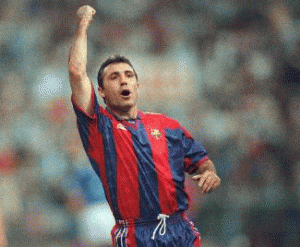
Hristo Stoichkov: The Bulgarian Messiah


"There are only two Christ’s; one plays for Barcelona, the other is in heaven," so said Hristo Stoichkov before collecting his award for European Footballer of the Year in 1994.

With Hristo directly translating as Christ, you could be forgiven for thinking he was joking and that it was a play on words...but you'd be wrong. Stoichkov had three massive elements to his person, a God-given skill, a God-sized ego, and a Devil of a temperament.

Starting his career as a mere 16-year-old with local team Hebros, Stoickov quickly became the bright young star of Bulgarian football. Even then, his technical skills stood out.

As a left-sided winger, he terrorised teams with his pace and precision and it came as no surprise to see CSKA Sofia, the biggest team in the country, come in for the young prodigy.

Within a year of signing for CSKA, they began to realise that this precocious talent also had a wild temper, and in 1985 he instigated a brawl in the Bulgarian Cup Final against Levski Spartak.

The game had become a wild affair with both sets of players guilty of X-rated assaults.

Although CSKA Sofia won 2-1, Stoichkov and six other players were suspended for three months each and both teams were formally disbanded in disgrace after the game.

CSKA Sofia had their name changed to CFKA Sredets and our young Stoichkov returned to action a couple of games into the next season.

He came back in imperious form and began to add goals to his game with Sredets now  employing him as a left-sided forward in their new 4-3-3 formation.

Around the same time, a Golden generation of player were beginning to come of age and none summed this up more than Stoichkov. Players like Yordan Letchkov, Illian Kiriakov, Krassimir Balakov, and the goal scoring machine of Emil Kostadinov were all starting to shine and European football was starting to realise that a new force was emerging.

With Stoichkov as the focal point, Sredets swept all aside in Bulgaria on their way to yet their third title in a row. Our prodigy was finally beginning to fulfil his promise and scored an incredible 38 goals in 30 games as he won the European Golden Boot.

Although it really wasn't until Sredets made a run in the European Cup Winners Cup that people outside Bulgaria finally realised just how ridiculously talented Stoichkov was.

During the journey to the semi finals, Sredets knocked out Panathinikos and Roda JC, before coming face-to-face with Johann Cruyff's "Dream Team" at Barcelona.

La Blaugrana won the two legged affair to progress to the final but it was Stoichkov who stole the show. Cruyff put in a bid immediately and snapped the young star up for the following season.

However, Stoichkov's fragile temper was to get the better of him. In his debut season at the Camp Nou he disagreed with a refereeing decision and starting shouting at the official before stamping on his foot, leaving the ref injured!

He was given a two-month suspension and Cruyff's decision to bring the volatile Bulgarian to the club was questioned at all levels. Despite the suspension, Stoichkov still managed to score 20 goals from midfield that season and the inquisition relented.

But not before Stoichkov questioned Barcelona's director's parentage...live on television!

The signing was to be the inspiration behind Barcelona's best-ever period. With Stoichkov pulling the strings from the left side of midfield, Cruyff's Barca went on to win the league for the next four seasons (91, 92, 93, 94), the European Cup (92), the European Super-Cup (92), the Copa Del Rey (90), the Super Copa de Espana (91, 92, 94).

The name "Dream Team" was truly deserved with players like Ronald Koeman, Bakero, Salinas, Michael Laudrup, Nadal, and current manager Josep Guardiola, not to mention Gheorghe Hagi, Romario, and Stoichkov himself, as Barcelona played some of the best football ever seen in Europe.

Hristo had come of age; he orchestrated every Barca attack with the skill of a composer.

His rapier-like attacks, slicing though every opposition, his technical skill unsurpassed, his dribbling sheer perfection, his passing impeccable, and his shooting laser perfect. Stoichkov deservedly won the European Footballer of the Year award in 1994.

During his time at Barca, he regularly clashed with his idol, Cruyff where the relationship between the two could be described as fractious at best. After one massive argument with Cruyff and the press, Stoichkov told them "I am not talking to any of you bastards until November!"

Cruyff’s response? Another argument!

It would be unfair to say that Stoichkov was a volcano constantly on the verge of eruption. In 1992, he paid for the 1992 European Cup Finals broadcasting rights for Bulgaria after the National broadcaster could not afford the fee and his amazing acts of benevolence have become the stuff of legend back home.

But something else was happening in Bulgarian football. Stoichkov, its undoubted star, now had ample support. Most of the country's best players had been exported to the top leagues in Europe and as the World Cup in America came around Bulgarian football was at an all-time high.

Stoichkov may have been part of the Dream Team at Barca, but he was also the centrepiece of Bulgaria's Golden Generation.

Without a World Cup win in their country's history, Stoichkov led a quietly confident Bulgaria team to USA ’94 but few gave them any chance of progressing after drawing Nigeria, Greece and Argentina in the group stage.

Their lack of experience showed in the first game when they froze against Nigeria who swept them aside with a comprehensive 3-0 win. With Greece up next before Argentina, a win was the minimum that Bulgaria needed to progress.

With Nigeria registering a big win against them and with Argentina destroying Greece 4-0, goal difference was always going to be a factor in deciding this group.

Bulgaria took to the pitch against Greece like men possessed and hammered them 4-0, with Stoichkov bagging two. Argentina beat Nigeria 2-1 to set the group up on a knife edge going into the last game.
Mathematicians all over the world still suffer headaches with this one.

As we entered the last group game, Argentina were top of the group with 6 points and a goal difference of +5, Nigeria had 3 points and +2, and Bulgaria had 3 points and +1. Depending on the result any team could go out as it would come down to a head to head battle.

The cut and thrust of it meant that Bulgaria had to win by two clear goals.

Their cause was helped by Diego Maradona's disqualification from the tournament after cocaine was found in his urine sample, something he strenuously denies to this day.

With Argentina reeling from the loss of their prime inspiration, Stoichkov missed out on the chance of a master vs. master battle that so many had looked forward to.

But he was not going to let Maradona's absence spoil his World Cup.

The game was a tight affair, with Argentina spoiling throughout, and Bulgaria found it hard to find a rhythm. Despite Stoichkov being under close attention from Argentinian defenders he was still the best player on the pitch.

In the 61st minute, Stoichkov and Bulgaria got the moment they had been waiting for. Balakov intercepted a cross from Caniggia and headed the ball wide to Kostadinov whose perfect pass sent Stoichkov racing through three Argentina defenders. As the keeper came out, he was coolness personified as he passed the ball into the back of the net to give Bulgaria a fighting chance.

Argentina packed out their defence and Bulgaria crashed upon their wall time and time again as they searched for that elusive goal.

As the game headed into injury time Argentina were actually top of the group but all that changed in the 92nd minute as Sirakov pounced to break Argentinian hearts and send Bulgaria through.

Argentina also went through as the best third-place team, but the damage had been done and they crashed out to a Hagi-inspired Romania in the next round.

Bulgaria's opponents in the Last-16 were Mexico who had topped a group containing Ireland and Italy. Once again Stoichkov was on the mark, scoring his country's only goal in the 1-1 draw. Bulgaria eventually progressing after they won the penalty shootout 3-1.

Germany were next up and in a match regarded by many as being the best of the tournament, Bulgaria won 2-1.

Lothar Matthaus had given Germany the lead right on the stroke of half time, but two goals in the space of three minutes from Stoichkov and Letchkov gave Bulgaria a memorable win.

After becoming the fans favourite because of their beautiful expansive football, Bulgaria found themselves paired in the semi finals with Italy.

Of all the teams remaining, Bulgaria were the only total footballing side left in the tournament. Italy and Brazil had been grinding results out from the start and Sweden were a tough well organised team, so Bulgaria found themselves as the people’s favourites.

As the pressure grew Italy produced their best performance of the competition. Roberto Baggio scored twice before Stoickov replied, but there was to be no way back and Bulgaria went out of the World Cup at the semi final stage.

It was a glorious defeat as Stoichkov won the Golden Boot, and was heralded as one of the world's greatest players.

Two years later, he left Barca for high-flying Parma in Italy. With Stoichkov gone Johann Cruyff's team failed to live up to the heights they had set and he was sacked the following year.

His time in Italy was an unhappy one, marked tightly by overzealous defenders, Stoichkov and his volatile temperament found it a difficult place to play.

Defenders constantly wound him up, and their "agricultural" play frustrated him deeply as he only managed to score five goals in an injury-plagued 23 games.

In 1996 Bobby Robson, seeking a leader and an inspiration for his Barcelona team, brought an aging Stoichkov back to the Nou Camp.

Although he could not inspire Barca to the league title, Barca did manage to win the UEFA Cup, the Copa Del Rey, and the European Super Cup in his two seasons there.

By the time the 1998 season rolled around, an injury hit 32-year-old Stoichkov was on the wane, and he went back to Bulgaria and CSKA Sofia to try to inspire the next generation.

Frustrated with his lack of game time, he decided to earn his coaching badges, and travelled the world for the next five years, gaining experience at lower levels.

The biggest impact he had during this time was when he smashed a student's leg apart while playing for DC United in the MLS; he was sued for this horrendous challenge and eventually settled out of court.

In 2004, he took over as manager of the Bulgarian national team and over the next three years they failed to make any kind of progress until he was sacked in 2007.

One of the best players ever to play in Europe was also one of the most volatile, but was also one of the most generous.

Stoichkov played like a God, lived like a God...and fought like a Devil.

May 20, 2010

History Of The World Cup Football 1930 to 2010


Football has changed greatly from the first World Cup in 1930. Players are fitter than ever before, football gear has changed from baggy shorts to tight fitting jerseys,  rules have changed to suit the attacking team, and believe it or not the roundness of the simple football has become something of a science all in itself.
The balls that were used in the 1930s are very much different from what we are used to now, literally made from a pig's bladder, they are now put together with the science and preciseness of space age technology.
Here is a brief history of the development of the one device that the game cannot exist without.

Apr 24, 2010

Spineless Arsene Wenger Is Turning Arsenal into a Version of Tottenham Hotspur

Arsenal's tilt at the title has ended yet again, although the Gunners did hang in for longer than most predicted. But the same old questions now need to be answered, the most prominent being: Why does Arsene Wenger not see what everyone else does?

As with any problem, there are a number of places to start—Is it Arsene's tactics, the players, the board, the lack of money?

Easiest place to begin is the current squad.

Arsenal has not improved enough on last season. Last year, they finished on 72pts; this year they have 71pts with three games to go. However, the Gunners title challenge was predicated on Chelsea and Manchester United's dropping of needless points, rather than their own radical improvement.

Only one player of substance joined the club last summer—Thomas Vermaelan for £10 million. Since coming in, the previously unknown Belgian international has gone on to have a fabulous debut season, but his arrival was only one baby step in the right direction.

That is because Wenger stuck with a few players who have always had questions surrounding them. The goalkeeping situation immediately springs to mind.

Since David Seaman left Arsenal in 2003, they have not had a top class 'keeper. Jens Lehmann might have been the man in goal in 2004, but he did make his fair share of mistakes in that amazing season and as the years went by, those mishaps became more and more common.

His replacement, Manuel Almunia, was another step backwards. The Spanish 'keeper simply is not good enough to win a league. He makes far too many mistakes, and it is amazing that his career at Arsenal has lasted for so long.

His current rival, Lukasz Fabianski, or "Flappyanski" as Gunners fans are beginning to call him, has enjoyed a torrid time as the net-minder on the few occasions he has managed to take to the pitch.
So if the goalkeeper problem is so obvious, then why hasn't Wenger brought in someone good?
It's not like there are no other good 'keepers out there.

Another problem is the centre of defence. Sure, Vermaelen has been good, and William Gallas has probably enjoyed his best season in an Arsenal jersey, but the flaky Frenchman is liable to self destruct at any moment.
As a good manager, Le Prof should be guarding against this by bringing in a player of stature.

Sol Campbell, but for his few man-of-the-match performances, is not the answer. Last season, Richard Dunne was allowed to leave Manchester City for a measly £5 million, and he is exactly the kind of player the Gunners need.

Then there's central midfield...

Many Arsenal fans feel there is nothing wrong with the current central midfield set-up. Alex Song is improving, Cesc Fabregas is brilliant, and whoever else slots in can play with the best of them.

Problem is, Song offers very little going forward, Fabregas offers very little going back, and the extra body offers very little when the chips are down.

Before I go any further, Cesc Fabregas is a fantastic player, a joy to watch, and one of my favourite players.
But...in building the current Arsenal team around him, Wenger has been forced to go with a five-man midfield.
Up until 2004, Le Prof usually played 4-4-2. The year after the Invincibles won the league, Cesc Fabregas became the main player in central midfield. Since then Arsenal have moved to 4-5-1 to cover his deficiencies.
It is also worth pointing out that Arsenal have not won a trophy since Cesc became the lynch-pin of the team.

For the bigger teams, Arsenal have become easier to play against. They are often out-fought in the critical area of central midfield, and that is one of the vital reasons why Arsenal are not challenging for titles.
They need to bring in a central midfielder who can do everything. An old fashioned player who can tackle, pass, shoot, and head the ball.

Song and Fabregas share these roles between them, and their partner—be it Samir Nasri, Denilson, or Rosicky—only provides support in one direction. It is such a critical area of the team, and Wenger has an eye for great midfielders.

Vieira and Petit were one of the best partnerships of the modern era, so it again begs the question, why hasn't Arsene tried to sign a similar player?

Up front, Arsenal only have one good striker. Robin van Persie is streets ahead of Niklas Bendtner, or Eduardo, or even Carlos Vela for that matter. They need to bring in a new forward badly. They won't win the league until they do.

One other problem that this current Arsenal team suffer from is that they are virgins.

They have never won anything, because they don't know how to win anything. They lack the nous, experience, and mentality needed to get over the finishing line. One competition that now deserves to be really looked at and treated with respect is the League Cup.

Back in the '70s Brian Clough took over a Nottingham Forest team that had never won a thing. During the time, there was a cup called the Anglo/Scottish Cup, the most disrespected trophy in football.

It was such an awful competition that nobody took it seriously, except Clough and Forest.

They went on to win it in 1977. That first win provided the foundation and desire to go on and win other trophies. Forest went on to win the League in 1978 and 1979, the League Cup in 78 and 79, the European Cup in 1979 and 1980, and the European Super Cup in 1979.

In short, a trophy that meant nothing provided the springboard for the most successful period in Nottingham Forest's history. Arsene Wenger and Arsenal could learn a few lessons from this alone.

Perhaps the biggest problem between Arsenal and winning the league is Arsene Wenger himself.

To win any league, the Champions must by flexible and pragmatic. Tactics must be changed on a whim to suit the occasion. In this aspect, Arsenal are unyielding.

In every season, there comes a time when the game plan has to be changed, and a new approach to the puzzle must be looked at. Arsenal do not change, no matter the opposition. Be they playing against Wigan or Stoke or Barcelona, the Gunners use the same game plan every time. In football, one size does not fit all.

Part of the reason for this is Arsene Wenger's faith in Cesc Fabregas, the 4-5-1, and the style of play they use. He has a beautiful philosophy on the game, and will not change it for anyone. It means that Arsenal will play their flowing game that appeases so many, because they and he have a certain expectation to live up to.
Fabregas deserves to have the team built around him, but Wenger must find the right players.

In 1958 the great Bill Nicholson took over as manager of Tottenham Hotspur. It was an announcement that surprised football.

He was known as a deep thinker on the game and had his own football philosophy, but he was not what you call a household name as far as management was concerned. A very similar figure to Arsene Wenger.
Nicholson had his own philosophies and beliefs and had great time for new scientific approaches to training and tactics. He revolutionised English football with this new approach he instilled in Tottenham.

Within a couple of years, Spurs went on to win the double—the FA Cup and the UEFA Cup—and challenged for the league every season. They only finished outside the top four three times over the next decade.

Tottenham Hotspur and good football became synonymous with each other, just as Arsenal and good football have done so since Arsene Wenger took over.
The problem that Spurs have is that history has dictated that Spurs play a certain way, which has resulted in them winning very little and not even challenging for years. Countless managers at Spurs have refused to become pragmatic.

While the same level of expectation is now bearing down on Wenger, and he won't go against his new beliefs, they have not won anything for the last five years. Le Prof too now believes that the game must be won a certain way.

In football, time moves quickly, far too quickly for some.

In 2004, not one person watching football would have said that the Gunners would win nothing for the rest of the decade. In 1990, nobody in their right minds would have said that it would be that last time that Liverpool would win the league.

Arsenal and Arsene Wenger are at a crossroads.

Le Prof has dithered with this experiment for far too long, and the club have accepted finishing in the top four as the height of their ambitions. Bringing money into the club through the Champions League has become the No. 1 goal for the every year, not winning trophies.

Wenger has to recognise that he has failed with this team, accept it, and move on to get their title challenge back on track. It only needs minor tweaking, and not a huge amount of spending.
Four players and Arsenal could win the league.

He needs to buy his team a strong spine; the one they currently have is too weak to win the title with.
A club with the modern history of Arsenal should not be waiting for their rivals to decline, they should be forcing them to decline, strangling the life out of them when the opportunity arises—just as Manchester United have done to Liverpool.

Arsenal should be doing that to United and Chelsea—and winning the English Premier League on their own terms.

Football is a simple game.

Le Prof is a genius of a manager. Surely he can figure this out?

Apr 18, 2010

Lionel Messi vs. Diego Maradona (Video of Identical Goals)


You would almost think that Messi's goal was created on photoshop it's that similar to Diego's famous effort against Manchester United.

Apr 6, 2010

Barcelona, Bunyodkor, Uzbekistan, and UNICEF

Amidst little fanfare in 2008, Barcelona announced a cooperative link up with an obscure team in Uzbekistan, Kuruvchi FC. It is a deal that has definitely benefited both clubs, but the commercial partnership has raised questions. Not least because the Uzbeki government has one of the worst records in the world for human rights violations, and that Barcelona are sponsored by UNICEF.

Initially the link up was on footballing grounds, with Kuruvchi players being allowed to train with and be trained by Barcelona players at Miniestadi during their winter break. The two clubs would then play a lucrative friendly before March 2010. Also, players such as Samuel Eto'o, Carles Puyol, and Andres Iniesta would travel to Tashkent, the capital, to cement the deal in the eyes of the media.


But who are Kuruvchi?

It might be news to many, but the club are now one of the world's richest teams, and are a powerhouse in Asian football, despite only being created in July 2005.

Initially when the club were created they were called Neftgazmontaj-Quruvchi, which was then shortened to Kuruvchi, which means "creator" in the Uzbek language. By 2008, The Swallows had won promotion twice and were playing in the highest league possible in Uzbekistan, the Uzbek Oliy League. In their first season in the Uzbek Premier League they won the double.

Shortly after the club changed their name to Bunyodkor and then announced a renewable yearly partnership deal with Barcelona. That season the club who had not existed a mere three years before made it to the semifinals of the Asian Champions League where they were eventually beaten by Australian outfit Adelaide United.

Bunyodkor then began to build a massive 15,000-seat stadium, where Barcelona President Joan Laporta planted the first brick in a huge PR exercise. Less than 18 months later and the club are on the verge of building a $150 million stadium, despite their 'old' stadium being only one year old.

With money being no obstacle, Bunyodkor began to attract some of the world's best players to enhance their growing reputation. Barcelona players Carles Puyol, Lionel Messi, Andres Iniesta, and Arsenal's Cesc Fabregas all received €1 million each to perform at a PR training school and to wear the Bunyodkor jersey for further publicity.

Not happy with just being linked with the games top stars through PR purposes, the club made an audacious bid to sign Samuel Eto'o and offered the Cameroonian star €25 million to play for club for just three months. He turned the deal down and chose to link up with Jose Mourinho at Inter Milan.

The club then moved to sign Rivaldo from AEK Athens . The 36-year-old will take home a reported $14 million for two years worth of his services. Zico then joined his fellow countryman for four months before he too was replaced with yet another wandering Brazilian, one Luiz Felipe Scolari . The World Cup winner had just been sacked by Chelsea and was looking for a new club.


Money Matters

How did a team rise from complete non-existence five years ago to become one of the richest clubs on the planet?

For this we have to go back to the name change of the club. When Kuruvchi were initially created they were representative of the local area. Seeing a glorious chance for international PR they changed their name, mid-season and without prior acknowledgement to anyone, to Bunyodkor, citing the main reason for this change as the club were no longer regional but national representatives.

The vice-president explained the economic expediency of the move this way:

“The number of sponsors and partners of the club has grown: it was four (official founders are Neftegezmontaj, UzGazOil , Gissarneftgaz and Kokdumalakgaz ), whereas now it has grown to 12. All these companies are involved in the creative sector of the country’s economy.”

That is why the club’s name was changed from “builder” to “creator”.

The badge of the club was changed during this stage too, to one almost identical to that of Barcelona's.

According to sources in Russia and Uzbekistan, the main money-men behind the club are Zeromax , and their alleged owner Gulnara Karimova . (wiki)

Gulnara Karimova is the daughter of Uzbekistan's President for life, Islam Karimov. Under his rule for the past 20 years, Uzbekistan has become one of the world's worst black-spots for human rights violations.


Human Rights

As recently as March 26 2010, Human Rights Watch found Uzbekistan's current record as being abysmal by international standards. During their study of the country, it was found that people were detained with impunity, that journalists and NGO's were regularly arrested simply because of their profession, and the use of torture and ill treatment was rampant.

The committee also raised the issue of child labour which is seen as being widespread throughout the country.

UNICEF , are the worlds leading child protection agency, and Barcelona's sponsor are heavily engaged in trying to bring about change in Uzbekistan.

During their studies on Uzbekistan it was found that unemployment is rife, almost 40 percent, and that the rate of children being left in orphanages to care for them is on the rise. Of these children roughly 10 percent are used for child labour like intensive cotton harvesting, while cases of child trafficking and child prostitution has also been reported.

It was also found during these studies by UNICEF and Human Rights Watch that the government were very lax when it came to applying international law for child labour.

Which brings us back to Bunyodkor and their alleged links with a government with a terrible human rights record.

There are many opponents to the regime in Uzbekistan. In 2009, Freedom House deemed Uzbekistan as being "the worst of the worst" in terms of civil rights abuses. While long time anti-Karimov campaigner Craig Murray has launched many scathing attacks on Uzbekistan's human rights abuses.

Murray was the British Ambassador to Uzbekistan between 2002 and 2004, before he was removed from his post after exposing civil rights abuses by the US funded Karimov government. His book Murder in Samarkand documented his two years in Tashkent and how the abuses and double standards employed by the British and American governments changed his beliefs and outlook on life. It will be released as a film in 2011.

In 2007, Murray wrote an article linking Alisher Usmanov with the Karimov government in Uzbekistan, and that he was the money behind both them and Gulnara. Since then "the hard man of Russia" has taken over a 25 percent stake in Arsenal FC.

When asked about Budyonkor's and Gulnara Karimova's rise, Murray had this to say.

"It's part of a campaign by the president to win popularity for his daughter. I hear that she will eventually replace him as president. The regime is trying to win popularity by the old-fashioned bread-and-circuses method."

To many political commentators she is seen as the only possible heir to her father, as she will be the only one able to protect both her and her father's assets and cronies.

Through pumping money into Bunyodkor, she has begun to change the face of the family and is seen as using the clubs supporters to gain credence for the governing political party that she is destined to take over.

The link up with Barcelona has certainly put Bunyodkor on the map.

It is somewhat ironic that Gulnara Karimova is now Uzbekistan's Ambassador to Spain, and this has fueled the speculation that she is considering buying RCD Mallorca.

Recently she held an auction with the donations set for various charities. During the sale she declared that she was representing UNICEF, something the organisation fiercely deny.

“UNICEF does not have any projects with Ms Karimova. We do not have any relations with Chopard,” the spokesperson said.

This did not put Karimova off, as she continued to declare UNICEF as her main sponsor.

In another event she enticed Sting to play in Uzbekistan for £1 million. When the British press found out about the event the singer was embarrassed into making an excuse. He used UNICEF as his shield. Something the organisation vehemently denied.

Gulnara also used Elton John for publicity during a visit to Los Angeles. The gay activist and AIDS campaigner was probably unaware that he was standing beside a representative of a government that would have jailed him for his sexuality and beliefs.

In 2006, Barcelona chose the moral high ground by letting UNICEF become the sponsor of their famous jersey. It was the first time in over 107 years that the club had allowed an emblem on their jersey.

At the time many cynical commentators alluded to Barcelona trying to tap into a new market by allowing the well known children's rights organisation sit proudly on their jersey.

"For the first time in our more than 107 years of history, our main soccer team will wear an emblem on the front of its shirt," said Joan Laporta the Barcelona president at a UNICEF executive committee meeting . "It will not be the brand name of a corporation.

"It will not be a commercial to promote some kind of business. It will be the logo of 'Unicef'. Through UNICEF, we, the people of FC Barcelona, the people of 'Barça', are very proud to donate our shirt to the children of the world who are our present, but especially are our future."

Barcelona have become involved with a team backed by an allegedly corrupt government, and one that has been accused of gross injustices, for a reported £5 million a year. While wearing the UNICEF logo, it would seem that Los Cules have many questions to answer.

Mar 29, 2010

Harry Redknapp's Transfer History, 1984 to 2010: The Best Record in Football?


Harry Redknapp is recognised as being the best English manager in the game today. He has always had a reputation of being a wheeler dealer. However, does he have the best transfer record in English football?

Between playing and managing, 'Arry's career has lasted over 40 years. With a playing career that lasted for 15 years and 276 games combined and a managerial career that has seen him manage in almost every division, Redknapp has seen everything the game has to offer.

Now in the twilight of his career, 'Arry is managing the biggest club of his career, Tottenham Hotspur, one of the great sleeping giants of English football.

Strangely enough, Redknapp began his career at the Spurs when, as an 11-year-old, he was brought to the club by chief scout, Dickie Walker. The love affair didn't last too long though, as West Ham snapped the promising youngster up at 15 and away from Bill Nicholson, who was just beginning to mould one of English football's greatest sides.

For the vast majority of his career, Redknapp was employed as a winger. An honest, skillful, industrious player, he played 149 times for the Hammers after making his debut at 17. From there he moved to Bournemouth for four years before a one game pit stop at Brentford, and then finally on to the NASL and the Seattle Sounders.

It was here in Seattle that Harry found the taste for management, acting as assistant manager for three years before becoming Bobby Moore's right hand man at Oxford United.

His first job in management was at Bournemouth, but he only got the job at the second attempt. Despite being the clubs assistant manager, he was overlooked when David Webb moved on to Torquay.

However, with the team floundering at the bottom of Division III under the new manager, Don Megson, the club was forced to act and they sacked their new manager handing the inexperienced Redknapp the task of saving the club.

Not only did 'Arry save the Cherries, but Bournemouth pulled off the biggest shock of the FA Cup when they dumped Manchester United out.

Redknapp had pulled off two major coups in only his first season as a manager.

Even then he had an eye for a player, and his very first signing was to offer one of the game's great journey men an in road into football, Steve Claridge.

Amazingly, between 1984 and 1992, Harry Redknapp only signed 19 players for Bournemouth and spent a massive £1.12million, but earned £1.77m during the same period.

Many of the players he signed were making their first forays into professional football. Looking back we can see that Redknapp had a keen eye for potential.

Steve Claridge, Sean Teale, Gavin Peacock, Efan Ekoku, Jamie Redknapp, Vince Bartram, and Jimmy Quinn are just a few names who all went on to bigger and better things after Bournemouth.

In 1987 the Cherries romped home as Division III Champions, but only lasted in Division II until 1989, when they were relegated.

In the summer of 1990, Redknapp was in Italy, watching the World Cup with friends when he was involved in a car accident which killed five people. A passenger in the vehicle, Redknapp was badly shaken and escaped relatively unscathed, only losing his sense of smell. He decided to take a break from football in 1992.

However, sometime later he returned to the fold in the guise of Head of Youth Development at West Ham.

In 1994 he was coaxed back into football with West Ham, who were struggling in the newly formed Premier League. Redknapp and Frank Lampard Sr. had been working tirelessly in the youth ranks at the Hammers and following Billy Bonds' resignation in August, they were promoted to first team affairs.

Again Redknapp went to work in the transfer market, except this time he augmented his work there with the internal promotion of some of the brightest talents in English football.

Between 1994 and 2001 at West Ham, he signed 58 players for the Hammers, spending £52.09 million, bringing £77.01 million into the club.

Again his work in the market can be judged by looking back at some of the 58 players he signed in that seven-year period.

Mark Rieper, John Hartson, Eyal Berkovic, Stan Laziridis, Steve Lomas, David Unsworth, Paulo Di Canio, Marc Vivien-Foe, Jermaine Defoe, and Igor Stimac are all prime examples of good signings during his West Ham years.

Young players like Mike Marsh, Joe Cole, Frank Lampard, Michael Carrick, Rio Ferdinand, and Joey Beauchamp all broke into the team under Redknapp too.

Of course there were some spectacular failures too, but they were few and far between. The two worst signings are Paulo Futre, who barely kicked a ball in anger for a whole season as one of the highest paid players in the league, and Florin Raduiciou.

It is worth knowing that at this time both of these players had huge reputations and initially looked like great deals for the club, however, the reverse was to be the case.

Both players commanded wages of something like £2.5 million a season on top of huge signing on fees, and are real examples of foreign signings that just did not work in England.

Those five-and-a-half years in charge at the Irons, Redknapp guided them to finish 14th, 10th, 14th, eighth, and a brilliant fifth.

Considering the resources available to him at West Ham these results were superb, but again Redknapp was vilified with being a wheeler dealer and a risk taker; it is only now that we can look back and see how much of a profit he actually made in his dealings.

He was unceremoniously sacked in May 2001 after he spoke to a fanzine over the signing of a new contract with the club, the club's chairman was extremely unhappy over comments Redknapp made at the time.

He was not out of work for long and he moved to Portsmouth as Director of Football in the summer of 2001.

Ironically, Redknapp took over as manager of the Division I club and guided them into the Premiership as Champions in 2002, replacing West Ham.

In just two years at Fratton Park, 'Arry signed 41 players for £7.65 million and sold 41 players for £5.4 million.

Redknapp resigned as manager of Portsmouth in November 2004 in dispute over the owner, Milan Mandaric, bringing in a Director of Football to the club.

Even though Redknapp only spent two years at the club, he did manage to bring in some real quality, namely Dejan Stefanovic, Lomano Lua Lua, and Yakubu.

He then made the controversial move down the coast to local rivals Southampton. Redknapp had been brought in as a fire fighter, with the job to save the club from almost certain relegation, which he was unable to do.

In just one season at the club he signed eight players for £2.57 million, but sold 18 players for £16 million as he began a clear out at the club.

That did not last too long though as Harry resigned after Southampton brought in England rugby manager Clive Woodward in a technical role at the club. Many felt that the rugby supremo was being lined up to learn from the wily old manager before replacing him.

A couple of weeks later, Redknapp was back in charge of Pompey who were hurtling out of control towards the second tier of English football.

However, there was to be a big difference at Portsmouth this time around. Alexandre Gaydamak, had just taken over, had made huge sums of money available to Harry in an effort to establish Portsmouth as a force in the Premiership.

Pompey finished four points above relegation that season ('05-'06), but the next ('06-'07) they finished a club record ninth. That was followed up the following season with another record season when Pompey finished eighth ('07-'08)

The club was on the crest of a wave and also won the FA Cup in 2008.

That was the beginning of the end, though, as Alexandre Gaydamak stepped down from the board and withdrew his backing, and all of a sudden Portsmouth were in trouble.

Backed up with Gaydamak's money, Redknapp was given permission to spend, and spend he did. £68.3 million left the club in just two seasons with only £29.07 million coming in while Redknapp held the reins.

As with his previous record, players of a high standard were brought to the club for cheap prices.

Niko Krancjar, Sulley Muntari, Glen Johnsen, Papa Bouba-Diop, and Jermaine Defoe are very good examples of Premiership players who were brought in to aid Portsmouth's cause.

It is worth noting that although Redknapp's time in charge of Portsmouth ended in a deficit of some £40 million, the club has since gone on to sell many of the players he signed while he was there, giving the club a staggering £103,940,000 million in sales in just three years. A massive profit of around £30 million for the struggling club.

In October 2008 Harry Redknapp took over relegation bound Tottenham Hotspur after Juande Ramos' ill fated reign.

Again 'Arry was quick out of the blocks as far as the transfer market is concerned, and re-signed Jermaine Defoe and Robbie Keane as well as bringing in Wilson Palacios to bolster midfield.

The new signings worked a treat as the Spurs roared up the league and only missed out on Europe on the final day of the season following a defeat at Anfield to Liverpool.

Last summer saw Tottenham strengthen their squad substantially by adding Peter Crouch, Niko Kranjcar, Sebastian Bassong, and Kyle Naughton to their ranks giving the Spurs a squad depth capable of challenging for Champions League positions.

As it stands, Tottenham are in a four-way fight to the death with Liverpool, Manchester City, and Aston Villa for the last Champions League qualifying position.

Harry Redknapp has had a remarkable career, over 1,000 games as manager, placing him in an elite band of men to achieve that rare milestone. While he has never managed a club that has challenged for trophies, he has become one of the best managers in the game through sheer hard work.

One thing that has really stuck with him throughout his career is his reputation for spotting a bargain.

Certain parts of his reputation are unfair, as he has had more successes than failures, and when you sit down and look at his transfer record over his 26 years as a boss you find that he has spent £208.23 million and recouped £230.37 million.

A quick comparison with Rafael Benitez has the Liverpool manager spending £210 million since 2004 and only accruing £125 million in the same period.

While in almost 24 years at Old Trafford, Alex Ferguson has spent £392.44 million on 89 players and made some £244 million by selling 216 players in that same time.

Arsene Wenger's record is quite impressive given the rewards he has managed to bring the club during his 13 years in charge.

Le Prof has brought 86 players to Arsenal at a cost of £220 million, and he has sold 162 for £194 million. A brilliant record, you'll agree, to almost break even after 13 long years.

Given the resources available to Ferguson, Wenger, and Benitez, it is little wonder that the three clubs are constantly challenging for the top three positions in the league.

Redknapp's record stands up for itself, a quite excellent record in the transfer market since 1984. He has never had the opportunity to manage a club with the resources to challenge for the title, but with Daniel Levy's backing you get the feeling the club would rather challenge than sit in mid-table.

Spurs' fans will be hoping that Redknapp manages to work some magic in the transfer market. He'll have to if they are going to make that huge step up and actually challenge for the Champions League positions, and maybe even the league someday.

Mar 18, 2010

Profiles Of The Great and Good: Arsenio Erico Finally Comes Home To Paraguay, 32 Years After His Death


32 years after he was laid to rest in Buenos Aires, Arsenio Erico, finally returned home to Paraguay. Thousands of fans showed up to pay tribute to the 'greatest striker in Argentinian league history' as they celebrated his repatriation.

Mar 12, 2010

Profiles Of The Great And Good: Roy Race, Its Real Roy of the Rovers Stuff Here...

Roy of the Rovers was by far the most popular football comic ever.

Running from 1954 to 2001, stories covered various issues—Roy as a teen trying to break into the famed "Melchester Rovers" team, winning every trophy imaginable, representing his country in the World Cup, playing with pop stars and even relegation.

He even had an unstoppable shot called the "Racy Rocket"....ah, those were the days.

Roy Race made his debut in the Tiger comic in 1954. Tiger was from the same stable as the famed "Eagle Comic" which focused on the science-fiction end of things, with Dan Dare as it's banner character.

Tiger was focused on real life, and all of it's stories were based in the "real" world. And this new direction proved to be an instant success. Readers took to football stories like proverbial ducks to water, with Roy of the Rovers becoming one of the most popular stories on the planet—in the '70s sales reached the million mark.

Considering the comic was weekly, that is some sales figure.

Beginning on September 11th 1954, Roy of the Rovers was the banner storyline in the Tiger Comic. Initially focusing on a teenage Roy as he tried to break into the first team at Melchester Rovers.

After a whole year in the youth team (story-lines were slow-burners in those days) Roy eventually made it into Melchester's first team and became a star. Roy won his first honour in 1957 (League Title) and over the next 46 years, it was a rare occasion for Roy to go a season without a trophy.

As was expected with most comics of this nature, it focused on the matches and scoring glorious goals against "cheating foreigners" but where Roy of the Rovers differed especially during it's golden period of the 70's and 80's was that it often featured side stories about training methods and the perils of being a footballer and the obstacles they have to overcome.

Most sport comics at the time required the reader to make huge assumptions and connect the panels together as the story progressed. The writers of Roy of the Rovers invented a novel method of doing this for the reader, in such a simple way that they didn't even notice it.

They had the crowd make comments during the matches. Nothing strange there, but the comments were carefully designed pieces of commentary. As if the reader had John Motson sitting on his shoulder.

By adding in lines such as "Race is looking to find Gray with a pass", "The keeper will never save that shot" etc., the commentary moved the story line of the match on with incredible ease.

That sometimes these whole paragraphs took place from the time the ball left Roy's boot to when it hit the back of the net never dawned on the average fan, it was all part of the beauty of story-telling.

And although the football matches were at the core of the comic, it often branched out in some strange directions.

Over the years, storylines saw Roy lapse into a coma after being shot, which was the starting storyline for when Roy eventually flew the Tiger coop and got his own comic, Roy of the Rovers.

In a storyline mimicking the famous Who shot J.R.? story, Roy was shot by an actor who played Roy on TV. Over the next couple of weeks the story captured the public's imagination (and mine) and for a short while it became an item that featured on the news as the comic became one of the most popular comics on the planet.

The Melchester team were even kidnapped by Arab terrorists, in this storyline the team escaped after being held captive for weeks, only to crash into a terrorist car laden with explosives.

Six of the Melchester United side were killed, and the story brought so much condemnation of it's stereotypical portrayal of the Middle-East, that the story-line was never referred to again.


This storyline in 1986 signalled the end for Roy, as readership levels began to steadily fall. The players killed in the explosion were replaced by pop-stars Martin and Gary Kemp from Spandau Ballet. Almost every match had a last gasp winner, and with the matches sometimes being stretched over three or four weeks (to keep people buying the comic) the readers began to grow bored.

In an attempt to regain high readership levels, the writers tried some other unusual gimmicks. One storyline saw an earthquake in Melchester cause subsidence under the stadium, and being left homeless, Melchester had nowhere to play.

Luckily enough a benefactor agreed to let them use Wembley for a season. How the writers thought that Roy Race playing at Wembley would boost figures is anybodies guess.

By this stage in 1993, readership levels were at an all time low, and the writers took the decision to curtail the weekly comic and go monthly instead. In another gimmick, other popular football comic stars of the past signed for Melchester.

Johnny Dexter "The Hard Man", Hot-Shot Hamish, Kevin "Mighty" Mouse, Billy Dane (Billy's Boots), Rick Stewart (Goalkeeper) and Blackie Gray all became Melchester players in a bid to centralise all the British football comic characters and to try to convince all of their fans to buy "one" comic.

The whole history of Melchester Rovers changed too. Roy's 40-year career was shortened to 10 years to make it more realistic. Opposition place names changed too, to mirror this new realism. Melchester didn't play against Everpool or Liverton anymore, the team-names were changed to reflect real areas such as Birkenhead, Toxteth, and Islington.

Failing to realise that these real names meant nothing to fans was a huge mistake. Fans knew that the writers couldn't use the real team names but they easily identified with teams like Everpool, Tyne Castle, Liverton, and Melchester. And although the new names reflected a certain realism, fans couldn't identify with them because they didn't know where the areas were or who they represented.


In another effort to drum up readership among ethnic minorities, Melchester signed a token Nigerian in 1994, just prior to the World Cup. Del Ntende was nicknamed "Delroy of the Rovers" and featured heavily but the writers attempts at reviving the comic were too little too late.

Finally the writers chose to "jump the shark".

Roy was on his way to see a prodigious youth play when his helicopter crashed. Over the next few weeks fans all over the world waited with baited breath to see if Roy would survive.

He did, but he had to have his trusted left foot amputated, and so ended the playing career of the greatest comic book player ever.

How the writers thought that this would save the flagging comic is mind-boggling.

Roy moved into management, first with A.C. Monza in Italy but then back to Melchester. But even he couldn't save the comic from finishing.

By the end of Roy of the Rovers final season as a comic, Roy had had his foot amputated. Blackie Gray had resigned after receiving death threats from fans, Melchester Rovers were in receivership and were on the verge of going out of business and Roy's son Rocky scored the winning goal in the FA Cup.

Like father, like son.

From the comics demise in 1995, various attempts have been made to bring Roy of the Rovers back from the dead. In 1997, BBC bought the rights to the comic, and they began to feature an on-going storyline in "Match of the Day" magazine.

BBC ran the comic strip until 2001, when they decided that the time was right for Roy to retire for good.

Roy of the Rovers is remembered fondly by all those who had the pleasure of reading it as a child. Especially those of us who are lucky enough to have read it in it's heyday of the 70's and early 80's.

It had a certain kind of charm, storylines were simple and not controversial back then. The miserable attempts by the writers in the late 80's and 90's to boost readership figures should be held in contempt for exactly what they were, soulless.

It's unlikely that we'll see a new Roy of the Rovers strip nowadays. People who were fans have moved on, and that kind of stuff isn't as popular with children of today. Times have changed.

However, in early 2008 worldwide publishing firm Titan Books announced that they had bought the rights to the entire back catalogue of Roy of the Rovers comics. And they hope to have them on the shelves in graphic novel format for Christmas this year.

If you know someone in their 30's or 40's, or even 50's who read the comic as a child, you could do a whole lot worse as a present for Christmas.

But lets honour the greatest player to ever play (in a comic).

Over his 55-year career, he won the league 10 times, the FA Cup 10 times, European Cup three times, Cup Winners Cup four times, UEFA Cup strangely only once, and the World Club Championships twice.

He even managed England. He scored 436 goals for Melchester and is the record goal scorer in English football.

The phrase "it's real Roy of the Rovers stuff" has even become a staple of any good commentator, especially when describing the unbelievable.

Not bad...for a comic.


Share

Mar 10, 2010

Harry Redknapp: His Transfer History 1984 to 2010, The Best Record In Football?

Harry Redknapp is recognised as being the best English manager in the game today. He has always had a reputation as being a wheeler dealer. However, does he have the best transfer record in English football?

Between playing and managing, 'Arry's career has lasted over 40 years. With a playing career that lasted over 15 years and 276 games combined with a managerial career that has seen him manage in almost every division, Redknapp has seen everything the game has to offer.

Now in the twilight of his career, Redknapp is managing the biggest club of his career, Tottenham Hotspur, one of the great sleeping giants of English football.

Strangely enough, Redknapp began his career at Spurs as an 11 year old when their Chief Scout, Dickie Walker, brought him to the club. The love affair didn't last too long though as West Ham snapped the promising youngster up at 15 and away from Bill Nicholson who was just beginning to mould one of English football's greatest sides.

For the vast majority of his career, Redknapp was employed as a winger. An honest, skillful, industrious player, he played 149 times for the Hammers after making his debut at 17. From there he moved to Bournemouth for four years before a one game pit stop at Brentford, and then finally on to the NASL and the Seattle Sounders.

It was here in Seattle that Harry found the taste for management, acting as Assistant Manager for three years before becoming Bobby Moore's right hand man at Oxford United.

His first job in management was at Bournemouth, but he only got the job at the second attempt. Despite being the clubs Assistant Manager, he was overlooked when David Webb moved on to Torquay.

However, with the team floundering at the bottom of Division 3 under the new manager, Don Megson, the club were forced to act and they sacked their new manager handing the inexperienced Redknapp the task of saving the club.

Not only did 'Arry save the Cherries, but Bournemouth pulled off the biggest shock of the FA Cup when they dumped Manchester United out.

Redknapp had pulled off two major coup's in only his first season as a manager.

Even then he had an eye for a player, and his very first signing was to offer one of the games great journey men an in road into football, Steve Claridge.

Amazingly, between 1984 and 1992, Harry Redknapp only signed 19 players for Bournemouth. Spending a massive £1.12million, but earning £1.77m during the same period.

Many of the players he signed were making their first forays into professional football. Looking back we can see that Redknapp had a keen eye for potential.

Steve Claridge, Sean Teale, Gavin Peacock, Efan Ekoku, Jamie Redknapp, Vince Bartram, and Jimmy Quinn are just a few names who all went on to bigger and better things after Bournemouth.

In 1987 the Cherries romped home as Division 3 Champions, but only lasted in Division 2 until 1989, when they were relegated.

In the Summer of 1990, Redknapp was in Italy, watching the World Cup, with friends when he was involved in a car accident which killed five people. A passenger in the vehicle, Redknapp was badly shaken and escaped reletively unscathed, only losing his sense of smell. He decided to take a break from football after the '91-'92 season.

In 1994 he was coaxed back into football with West Ham who were struggling in the newly formed Premier League. Redknapp and Frank Lampard Sr. had been working tirelessly in the youth ranks at the Hammers and following Billy Bonds' resignation in August, they were promoted to first team affairs.

Again Redknapp went to work in the transfer market, except this time he augmented his work there with the internal promotion of some of the brightest talents in English football.

Between 1994 and 2001 at West Ham, he signed 58 players for the Hammers, spending £52.09 million, bringing £77.01 million into the club.

Again his work in the market can be judged by looking back at some of the 58 players he signed in that seven year period.

Mark Rieper, John Hartson, Eyal Berkovic, Stan Laziridis, Steve Lomas, David Unsworth, Paulo Di Canio, Marc Vivien-Foe, Jermaine Defoe, and Igor Stimac are all prime examples of good signings during his West Ham years.

Young players like Mike Marsh, Joe Cole, Frank Lampard, Michael Carrick, Rio Ferdinand, and Joey Beauchamp all broke into the team under Redknapp too.

Of course there were some spectacular failures too, but they were few and far between. The two worst signings being Paulo Futre who barely kicked a ball in anger for a whole season as one of the highest paid players in the league, and Florin Raduiciou.

It is worth knowing that at this time both of these players had huge reputations and initially looked like great deals for the club, however, the reverse was to be the case.

Those five and a half years in charge at the Irons, Redknapp guided them to finish 14th, 10th, 14th, 8th, and a brilliant 5th.

Considering the resources available to him at West Ham these results were superb, but again Redknapp was villified with being a wheeler dealer and a risk taker and it is only now that we can look back and see how much of a profit he actually made in his dealings.

He was unceremoniously sacked in May 2001 after he spoke to a fanzine over the signing of a new contract with the club, the clubs chairman extremely unhappy over comments Redknapp made at the time.

He was not out of work for long and he moved to Portsmouth as Director of Football in the summer of 2001.

Ironically, Redknapp took over as manager of the Division 1 club and guided them into the Premiership as Champions in 2002, replacing West Ham.

In just two years at Fratton Park, 'Arry signed 41 players for £7.65 million and sold 41 players for £5.4 million.

Redknapp resigned as manager of Portsmouth in November 2004 in dispute over the owner, Milan Mandaric, bringing in a Director of Football to the club.

Even though Redknapp only spent two years at the club, he did manage to bring in some real quality, namely Dejan Stefanovic, Lomano Lua Lua, and Yakubu.

He then made the contoversial move down the coast to local rivals Southampton. Redknapp had been brought in as a Fire Fighter with the job to save the club from almost certain relegation, which he was unable to do.

In just one season at the club he signed eight players for £2.57 million, but sold 18 players for £16 million as he began a clear out at the club.

That did not last too long though as Harry resigned after Southampton brought in England Rugby manager Clive Woodward in a Technical Role at the club, many felt that the Rugby supremo was being lined up to learn from the wily old manager before replacing him.

A couple of weeks later and Redknapp was back in charge of Pompey who were hurtling out of control towards the second tier of English football.

However, there was a to be a big difference at Portsmouth this time around. Alexandre Gaydamak had just taken over and made huge sums of money available to Harry in an effort to establish Portsmouth as a force in the Premiership.

Pompey finished four points above relegation that season ('05-'06), but the next ('06-'07) they finished a club record 9th. That was followed up the following season with another record season when Pompey finished 8th ('07-'08)

The club was on the crest of a wave and also won the FA Cup in 2008.

That was the beginning of the end though as Alexandre Gaydamak stepped down from the board and withdrew his backing, and all of a sudden Portsmouth were in trouble.

Backed up with Gaydamak's money, Redknapp was given permission to spend, and spend he did. £68.3 million left the club in just two seasons with only £29.07 million coming in while Redknapp held the reigns.

As with his previous record, players of a high standard were brought to the club for cheap prices.

Niko Krancjar, Sulley Muntari, Glen Johnsen, Papa Bouba-Diop, and Jermaine Defoe are very good examples of Premiership players who were brought in to aid Portsmout's cause.

It is worth noting that although Redknapp's time in charge of Portsmouth ended in a deficit of some £40 million, the club has since gone on to sell many of the players he signed while he was there, giving the club a staggering £103,940,000 million in sales in just three years. A massive profit of around £30 million for the struggling club.

In October 2008 Harry Redknapp took over relegation bound Tottenham Hotspur after Juande Ramos' ill fated reign.

Again 'Arry was quick out of the blocks as far as the transfer market is concerned, and re-signed Jermaine Defoe and Robbie Keane as well as bringing in Wilson Palacios to bolster midfield.

The new signings worked a treat as Spurs roared up the league and only missed out on Europe on the final day of the season following a defeat at Anfield to Liverpool.

Last summer saw Tottenham strengthen their squad substantially by adding Peter Crouch, Niko Kranjcar, Sebastian Bassong, and Kyle Naughton to their ranks giving Spurs a squad depth capable of challenging for the Champions League positions.

As it stands, Tottenham are in a four way fight to the death with Liverpool, Manchester City, and Aston Villa for the last Champions League qualifying position.

Harry Redknapp has had a remarkable career, over 1,000 games as manager, placing him in an elite band of men to achieve that rare milestone. While he has never managed a club that have challenged for trophies, he has become one of the best managers in the game through sheer hard work.

One thing that has really stuck with him through out his career is his reputation for spotting a bargain. Certain parts of this reputation are unfair as he has had more successes than failures and when you sit doen and look at his transfer record over his 26 years as a boss you find that he has spent £208.23 million and re-coupled £230.37 million.

A quick comparison with Rafael Benitez has the Liverpool manager spending £210 million since 2004 and only accruing £125 million in the same period.

While in almost 24 years at Old Trafford, Alex Ferguson has spent £392.44 million on 89 players and made some £244 million by selling 216 players in that same time.

Arsene Wenger's record is quite impressive given the rewards he has managed to bring the club during his 13 years in charge.

Le Prof has brought 86 players to Arsenal at a cost of £220 million, and he has sold 162 for £194 million. A brilliant record you'll agree, almost break even after 13 long years.

Given the resources available to Ferguson, Wenger, and Benitez, it is little wonder that the three clubs are constantly challenging for the top three positions in the league.

Redknapp's record stands up for itself, a quite excellent record in the transfer market since 1984. He has never had the oppurtunity to manage a club with the resources to challenge for the title, but with Daniel Levy's backing you get the feeling the club would rather challenge than sit in mid table.

Spurs' fans will be hoping that Redknapp manages to work some magic in the transfer market. He'll have to if they are going to make that huge step up and actually challenge for the Champions League positions.


Share

Mar 6, 2010

Profiles Of The Great and Good: Arthur Friedenreich: The Original “Black” Pearl.

What do you get if you cross a German Footballer and a Brazilian Footballer? You get Arthur Friedenreich, the greatest goalscorer the world has ever seen. He scored more goals than Pele, furthered civil rights, had a 26 year career and got his teeth kicked in.

Mar 3, 2010

Was Aaron Ramsey's Injury A Result Of Declining Coaching Standards?

Recriminations and questions have been flying since Aaron Ramsey picked up an horrific leg break following Ryan Shawcross' tackle. Perhaps the most pertinent being, was the tackle a result of a fall in coaching standards at both clubs?

As with any incident in a football match, there are a million little things that have to happen first.

The episode began with Ryan Shawcross in possession. Although there were a few Arsenal players in attendance, he wasn't under what you would consider as being heavy pressure.

Shawcross' touch here was unusually heavy, letting the ball drift from his sphere of influence to where an opposing player could easily attack the ball.

With the ball now in no-man's land, Aaron Ramsey's quicker reaction meant he was going to get to the ball first.

However, the Arsenal player was not going to be in a position to take possession, hence his stretched attempt to stab the ball away from the on rushing Shawcross.

In this section of the episode, Ramsey attacked the ball wrong.

Seeing that Shawcross was coming in, full forced to attack the ball, the Arsenal youngster had two options.

1) Tackle side on, thus protecting himself in the challenge.

2) Get both feet as close to the ball as possible thus allowing himself to prod the ball away and jump at the same time, avoiding the challenge.

His inexperience showed here as he stretched into the tackle and prodded the ball away. With his feet set so far apart, he had no other choice than to plant his foot in the ground for balance.

Meaning that when Shawcross came in for the ball that was not there anymore he made contact with Ramsey's leg.

The Arsenal player had not protected himself, nor set himself up to avoid the challenge, his foot could not move, and he ended up with an horrific break.

Going back to Shawcross' lunge.

This tackle is what is known as a statement tackle. It is one of the most important parts of the game, such a tackle can be as good as a goal in regards to lifting players and fans alike, as well as being a massive psychological blow to the opposing team.

Having lost possession with his poor touch, Shawcross was left with no other option that to tackle, and he chose to make a statement.

The thing about these kind of tackles is that you do not make them in 50/50 type challenge. The secret to these is that they are as close to guaranteed tackles as you can make, thus allowing yourself the extra power to clatter into your opponent, letting him know he's in a game.

In short, Shawcross chose the wrong tackle.

Then he tackled with the wrong leg.

By coming across Ramsey with his right leg, which was further away, Shawcross stretched and came down upon where the ball used to be.

Had he used his left, as he should have, his natural inclination would have been to either block tackle the ball, or slide in. Either decision and Ramsey would have probably come off without a broken leg.

Had both players tackled properly and neither player would have been injured.

Tackling is a skill, as equally important as heading or scoring or passing. When done right, it is a thing of rare beauty.

One of the reasons that makes football such a wonderful sport is that it caters for every type of player. Big, small, fast, slow, precocious youth or wily old journeyman.

Small players like Lionel Messi can outwit the big cumbersome defender through trickery and guile.

While the untalented player can out fight his more illustrious opponent if his work rate and determination is not matched.

Last weekend two cultures that should be allowed to exist side by side clashed and the result was Aaron Ramsey breaking his leg.

Some have been quick to point the finger at Stoke's style and Shawcross' impulsive challenge.

We now have the knowledge that an average of almost 20 injuries are incurred per game, ranging from niggles that almost go unnoticed to injuries that keep players on the sidelines for indefinite time periods.

67 percent of all injuries that are picked up are based in the lower extremities (from the knee down) and the most common injury being damaged ankle ligaments, which were four times more likely to happen during practice.

However, football should be allowed to exist in it's current state. These occurrences are rare, but are as likely to happen on the training ground as on the field of play.

Which brings us back to coaching standards.

Passing, shooting, heading, etc are all technical skills and are easily practised and taught. Tackling however, is one of the hardest parts of the game to educate upon, and is glossed over by many coaches.

Had either player been thought to tackle correctly in that situation, and nobody would have been hurt.

To read about FIFA's campaign to ban tackles such as these click here

Share

Mar 2, 2010

Stoke City's Glen Whelan, The Only Player On The Pitch To Keep His Head Following Aaron Ramsey's Horror Injury

Ryan Shawcross clattered into Aaron Ramsey, his leg shattered and the promising youth lay screaming on the ground. His Arsenal team mates screamed, vomited, and held their heads, leaving Stoke's Glen Whelan as the only man cool enough to comfort the stricken youth.

While all around him lost their heads, Stoke City's Irish midfielder, Glen Whelan, was the first man to react in proper fashion to Ryan Shawcross' tackle.

The young Welsh midfielder was enjoying only his seventh start of the season, when "that tackle" ended the game prematurely for him. For many Arsenal fans and players alike, Ramsey represents the future of the club. He is expected to pick up the mantle of midfield maestro if and when Cesc Fabregas decides to go home to Barcelona.

As he lay on the ground, white with shock, his ankle dangling at an awkward angle, his Arsenal compatriots simply lost their heads.

For a few moments they forgot that Aaron was a team mate and player, that he was only 19, they only saw him as a symbol of the clubs future.

Some players chased after the referee demanding him to send off Shawcross, some actually turned and vomited, such was the devastation on show, some chased the Stoke defender seeking retribution.

Glen Whelan was the only player on the pitch who managed to show anything like composure. Compared to his fellow professionals on show, the Stoke player was literally the personification of cool.

He kneeled gently beside Ramsey cradling his head in one hand, clutching his hand in the other and whispered to him, telling him to "stay calm, everything would be all right."

His first task was to position himself in such a way that Ramsey could not see his leg, thus protecting the youth from certain shock. He then called to a motionless Nicklas Bendtner, getting him to snap out his trance and told him to help his stricken colleague.

Ten yards away a melee was ensuing...

"I was trying my best to take his mind off it, telling him not to think about it or to look at it."

"He knew straight away how bad it was, though. He just kept saying 'my leg, my leg'."

"I went there because I was closest to him. I had to."

"He held onto me with the pain he was going through. I think he went into a state of shock when it happened, so I was just trying to do what I could (for him)."

Whelan has defended his team-mate Ryan Shawcross, saying that the replays prove there was no malicious intent. "A hard tackle, but not a dirty tackle," he argued.

"The two lads could go into a tackle like that 100 times again, and nobody would come off injured."

"Well, I haven't seen it again and if I had a chance to see it, I'd turn the telly off," he said. "There's young people who couldn't stomach it.

"The Premier League and the two clubs need to sit down and watch it again. I think that's ok, but I think Sky were right not showing it because it can make people queasy. Of course, it's a contact sport and these things happen. Thankfully they don't happen too often."

Whelan had yet to sign for Stoke, when in October 2006, Rory Delap suffered the exact same injury against Sunderland. The Irishman returned to action as good as ever in July 2007 and went on to play 46 matches for Stoke the following season.

"It's the first time that I had ever experienced anything like that and, touch wood, I hope I never have to see anything like that again."

"First and foremost, I just hope that the young lad (Ramsey) gets back as soon as possible."

Share

I Hate...A Rant By An Angry QPR Fan

This rant appeared on a forum for QPR, classic.

I take more pleasure in seeing Chelsea lose than I do in seeing QPR
win at the moment.

I sat through so many matches when we were absolute dogs**t under the
likes of Ray Harford and with people like Paul Bruce, Matthew Brazier
and Mark Perry in the squad and I never felt like this.

The club isn't ours anymore but moreso than that - football is just
properly gash these days.

I mean really gash.

football generally.

I hate nearly everything about it these days....

I hate the Prem and the myth that it is exciting this year. Man City
breaking into the top four isn't exciting. They spent loads of money.
It's no more exciting that Nameless C*** getting to number 1 in the
charts after winning the X-Factor.

I hate the myth of Arsene's kids. Buying some French kid when he's
17, playing him in the League Cup and then selling him when he's 20
after about 3 appearances in the league is NOTHING SPECIAL.

I hate hearing about Liverpool/Man Utd's debt but nothing ever
happening about it. A club needs to go to the wall for the money
thing to change but it doesn't happen. Why the **** are Charlton,
Leeds and Southampton still in business?

I hate Frank Lampard's stupid f'ing face. I hate John Terry being
England captain when he's CLEARLY AN OAF.

I hate the England team.

I hate young exciting wingers who have nothing but pace. Tony Scully
had nothing but pace.

I hate the FA Cup. There may be little shocks like last night but for
the most part you know who's going to win it. Unless a team throws
away all their financial security to win it a la Pompey.

I hate Harry f'ing Redknapp. And Jamie Redknapp. And Louise Redknapp.
And the Wii.

I hate James Nesbitt, Eammon Holmes and f***ing everyone.

I hate Gary Lineker and Alan Shearer.

I hate Garth Crooks.

I hate Garth Brooks for that matter.

I hate Sky Sports.

I hate that when a lower league player beats 10 players and chips the
keeper it doesn't matter but if Rooney scores from more than 20 yards
it's amazing.

I hate that everything football related has to have 'Club Foot'
playing behind it.

I hate that female sports journos are now mandatory.

I hate Mark Lawrensen for not coming out. 'I do like a big man at the
back'. I bet you do.

I hate any advert that portrays football to be about anything other
than pain and disappointment.

I hate any advert that mentions pies at football.

I hate Lee Hughes and the fact that he makes a living from the game.
I hate Marlon King and any team that signs him when he gets out. I
hate that it'll probably be us.

I hate Phil Brown.

I hate 'well the ball is a lot lighter now and will cause goalkeepers
real problems this summer' before EVERY F'ING TOURNAMENT.

I hate that Kieron Dyer earned more in the time I took to write this
post than I'll earn this month.

I hate Adrian Durham, Ian Wright and Alan Brazil.

I hate Gazza. Either die or shut up. Stop f'ing lingering.

I hate hearing about Hillsborough more than I hear about Heysel or
Bradford.

I hate that a comeback from 4-0 down at half time (TWICE) means
nothing because we aren't f'ing scouse.

I hate Leeds.

I hate Roy Keane.

I hate grown men wearing football shirts of their team whilst
shopping on a saturday when their team is playing at home.

I hate that I don't hate Roy Hodgson.

I hate Jermaine Beckford and any player who has neck tattoos.

I hate songs being inappropriately taken as club anthems and then
sung in a manly way. 'I'm forever blowing bubbles....'. Gaylords.

I hate Danny Dyer and anyone he's ever interviewed.

I hate the book 'Cass' by Cass Pennant. It is honestly the stupidest
thing I've ever read. Chapter 1: Millwall. 'Yeah we took 50 to
Millwall. They had 1000 in their mob but we ran 'em up and down the
street'. Chapter 2: Liverpool. 'Yeah we took 50 to Liverpool. They
had 2000 in their mob but we ran 'em up and down the street'. Fk
me... Jade Goody's autobiography is probably better. Even her
non-ghost written one.

I hate that all good youngsters end their careers at Spurs before they start.

Share

Dec 11, 2009

Liverpool vs. Arsenal 2009 Vintage; Not The 1989 Classic


On the 26th of May, 1989, Liverpool and Arsenal played in the final game of the most nail-biting league finish of all time. On Sunday, they meet in a match that is sadly just another in the calender year...

Nov 14, 2009

Ars Bandeet and Other Funny Names From The Wonderful World of Football


Never heard of Ars Bandeet? How about Einar Aas? No? Well everyone's heard of Segar Bastard, haven't they? For every Diego and Pele, there has been an Ars or an Aas. Here are a couple of the greatest names ever to grace a football pitch...

Apr 18, 2009

The Fast and the Furious: The Fastest Goals in Football

There have been many column inches dedicated to Cristiano Ronaldo's wonder goal against Porto in the UEFA Champions League. A goal of such breathtaking beauty that it left even the most experienced of journalists scrambling for words to describe the strike.

At 65mph, the ball left Ronaldo's foot like an exocet missile and shook the back of the net while the 'keeper just looked on like a spectator. Everyone was in agreement that it was a special goal, especially Ronaldo.

But was it one of the fastest goals ever scored?

Mar 24, 2009

Profiles of the Great and Good: Hristo Stoichkov: "There Are Only Two Christs...The Other Is in Heaven"


"There are only two Christs; one plays for Barcelona, the other is in heaven," so said Hristo Stoichkov before collecting his award for European Footballer of the Year in 1994.

With Hristo directly translating as Christ, you could be forgiven for thinking he was joking and that it was a play on words...but you'd be wrong. Stoichkov had three massive elements to his person, a God-given skill, a God-sized ego, and a Devil of a temperament...

Mar 13, 2009

After 22 Years, Shamrock Rovers Finally Have a Place to Call Home


This night took 22 years to make. The most storied, celebrated, and successful team in Irish soccer have finally come home.

Just over two decades ago, Shamrock Rovers had Glenmalure Park sold from under them, in the intervening time frame they have travelled the length and breadth of the country to play their home matches...